
Introduction
The Rexroth A4VG is a high-performance variable displacement axial piston pump engineered for closed-loop hydrostatic drive systems across construction, agricultural, and industrial machinery. Operating at peak pressures up to 450 bar, these precision pumps demand consistent, rigorous maintenance to sustain system reliability and prevent catastrophic failure.
Neglecting A4VG maintenance creates a cascade of problems: internal contamination damages precision-machined surfaces, charge pressure loss starves the closed loop and triggers cavitation, and bearing wear accelerates into complete pump seizure. A single unplanned pump failure can sideline a machine for days — far exceeding what routine service would have cost.
This guide covers the essential maintenance principles for the A4VG, including maintenance types, early warning signs, a practical hour-based service schedule, and common repair areas. Whether you're managing a fleet of excavators or maintaining agricultural equipment through harvest season, understanding these fundamentals protects your pump and keeps your equipment on schedule.
Key Takeaways
- The A4VG operates at extreme pressures with tight tolerances — contamination or charge pressure loss escalates quickly into full system failure
- Preventive maintenance costs a fraction of reactive repair or emergency replacement
- Monitor charge pressure (25 bar nominal, 40 bar max), case drain flow, and fluid cleanliness consistently
- Follow hour-based service intervals, not calendar schedules — high-duty applications demand shorter cycles
- Rebuild services with testing and warranty coverage reduce downtime more reliably than most in-house repairs
Why Maintaining Your A4VG Hydraulic Pump Matters
The A4VG operates in closed-loop circuits at pressures reaching 450 bar peak, where precision internal tolerances leave zero margin for error. Degradation from contamination or wear directly translates to lost system efficiency, reduced controllability, and unpredictable machine response. When charge pressure drops or particles exceed ISO cleanliness targets, the damage begins immediately.
Performance Impact of Deferred Maintenance
Deferred maintenance manifests in measurable performance loss:
- Reduced displacement output and slower machine response
- Inconsistent servo control and difficulty holding load pressure
- Increased cycle times that impact productivity
- Erratic travel speed or implement movement
Lifespan and Design Life Expectancy
A well-maintained A4VG can deliver tens of thousands of operating hours — manufacturers typically design these pumps for 10,000 to 20,000 hours under proper conditions. Neglected units often fail before 5,000–10,000 hours, with contamination and low charge pressure accounting for the majority of premature failures.
Safety and Compliance Implications
Uncontrolled pressure loss or pump seizure in mobile machinery creates immediate safety hazards for operators. ISO 4413 and machinery-specific safety standards mandate regular hydraulic system inspection to prevent uncontrolled motion, pressure spikes, and component failures that can injure personnel or damage equipment.
The Cost Argument
Industry data shows preventive maintenance runs 30–40% of reactive repair costs. Emergency A4VG replacement (expedited shipping, post-contamination system flushing, and lost production) can easily exceed $15,000–$25,000.
Scheduled fluid changes, filter replacements, and charge pressure monitoring cost a fraction of that — and prevent the secondary damage that inflates total repair bills:
- Fluid and filter changes: Routine cost, typically under $500 per service interval
- Charge pressure monitoring: Near-zero cost with basic instrumentation
- Early fault detection: Avoids cylinder block and valve plate damage that multiplies repair scope
Types of A4VG Maintenance
The A4VG requires a layered maintenance strategy. Routine fluid and filter care handles daily reliability, while condition monitoring and periodic overhauls address deeper wear mechanisms before they cause failure.
Routine / Preventive Maintenance
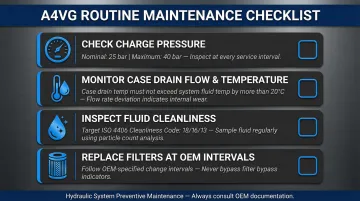
Routine A4VG preventive tasks include:
- Checking charge pressure — verify 25 bar nominal (40 bar max absolute) at the charge port using a calibrated gauge
- Monitoring case drain flow and temperature — elevated flow or temperature indicates internal bypass
- Inspecting fluid cleanliness — target ISO 4406 cleanliness levels (typically 18/16/13 or better for A4VG systems)
- Replacing filters at OEM intervals — both high-pressure and charge circuit filters
Routine maintenance alone suffices for lower duty-cycle applications with stable operating temperatures and clean fluid environments, such as intermittent-use construction equipment or climate-controlled industrial systems.
Corrective / Reactive Maintenance
Reactive A4VG repair typically follows:
- Sudden loss of drive power or implement speed
- Excessive case drain flow indicating internal bypass
- Contamination event from filter failure or external ingress
Letting minor issues go unaddressed — such as slow charge pressure drop or gradual increase in case drain temperature — allows wear to progress into full failure. Precision pumps like the A4VG suffer secondary damage when operated in degraded condition: scored cylinder barrels, damaged valve plates, and worn swashplate surfaces inflate total repair costs well beyond what early intervention would have required.
Predictive / Condition-Based Maintenance
Condition monitoring approaches suited to the A4VG include:
- Trending case drain flow rate — a leading indicator of internal wear and bypass
- Charge pressure trending over time — gradual decline signals boost pump wear or relief valve drift
- Fluid particle count analysis — catches contamination before it damages internal surfaces
- Case drain port temperature monitoring — elevated temperature reveals excessive internal leakage
Data-driven maintenance allows technicians to schedule pump service during planned downtime rather than reacting to failure, improving uptime and reducing total cost of ownership.
Major Overhaul / Exchange
A major A4VG overhaul involves:
- Full disassembly and inspection of the rotating group (cylinder barrel, pistons, retainer plate)
- Valve plate and servo control component inspection
- Shaft seal and bearing replacement
- Reassembly to manufacturer torque and clearance specifications
When in-house overhaul capability is limited, professional rebuild and exchange programs offer factory-spec rebuilt units with warranty coverage. Hydrostatic Transmission Service's Short-Time Exchange program, for example, provides quality-tested A4VG units that minimize downtime compared to waiting for a bench repair. Units are rebuilt to manufacturer specifications, tested for charge pressure and displacement, and backed by a one-year warranty.
How to Tell If Your A4VG Pump Needs Service
Catching early warning signs prevents minor wear from becoming catastrophic failure. Technicians and operators should monitor these primary diagnostic indicators.
Performance and Drive Output Changes
Performance red flags include:
- Reduced travel or implement speed that cannot be explained by load conditions
- Inability to reach full system pressure
- Sluggish response from servo or proportional control
- Difficulty holding load pressure during operation
These symptoms typically point to internal bypass or servo circuit degradation — start by verifying charge pressure before pulling the pump for bench inspection.
Charge pressure loss is one of the most critical A4VG-specific indicators. According to official Rexroth documentation, nominal charge pressure should be 25 bar absolute (not the commonly misquoted 18–28 bar range), with a maximum of 40 bar absolute. If charge pressure falls below specification, the closed-loop circuit cannot properly replenish fluid losses, leading to cavitation damage on the rotating group.
Abnormal Noise, Heat, and Vibration
A4VG-specific acoustic warning signs include:
- High-pitched whining or cavitation noise — indicates low charge pressure or aerated fluid
- Knocking from the rotating group — signals bearing or piston shoe wear
- Unusual vibration at the drive shaft — suggests imbalance or coupling wear
Case drain temperature rising more than 10–15°C above tank temperature points to excessive internal leakage or fluid degradation. Larger differentials don't resolve on their own — schedule service before secondary damage compounds.
Visible Leaks, Contamination, and Error Indicators
External indicators requiring immediate attention:
- Shaft seal leakage — common after extended service or thermal cycling
- Milky or discolored hydraulic fluid — indicates water contamination
- Metallic particles — found in fluid or on filter bypass indicators
Machines with A4VG-equipped hydrostatic drives may generate fault codes for pressure deviation or servo response errors that surface before physical symptoms appear. Monitor diagnostic systems closely and investigate any pressure-related error codes immediately.
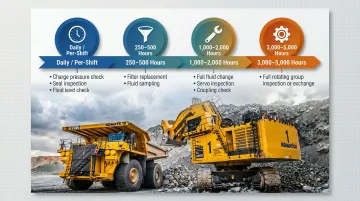
A4VG Pump Maintenance Schedule
Skipping or delaying A4VG maintenance is the fastest route to rotating group failure and unplanned downtime. Service intervals are hour-based and scale with application severity — high-duty continuous operation demands tighter schedules than intermittent-use equipment.
Structured Maintenance Frequency
| Interval | Tasks |
|---|---|
| Daily / Per-Shift | Verify charge pressure at startup (25 bar nominal) · Check for shaft seal leaks · Confirm fluid level and temperature within normal range |
| Every 250–500 Hours | Replace high-pressure and charge circuit filters · Sample hydraulic fluid for particle count and viscosity · Inspect case drain hose condition |
| Every 1,000–2,000 Hours (or Annually) | Full hydraulic fluid change · Servo control linkage inspection · Check pump mounting and drive coupling for wear · Pressure-test charge relief valve setting |
| Every 3,000–5,000 Hours (or End of Design Life) | Full rotating group inspection or exchange — assess cylinder barrel, valve plate, piston shoes, and shaft bearing for wear beyond tolerance |
Environment-Specific Adjustments
Operating environment has a direct impact on how far you can stretch each interval:
- Contaminated environments (construction sites, forestry, dusty agricultural conditions): cut all intervals by 30–40%
- Clean, temperature-controlled applications (indoor manufacturing): intervals may be extended when fluid analysis confirms cleanliness and viscosity are within spec
Common A4VG Repair Areas and Service Procedures
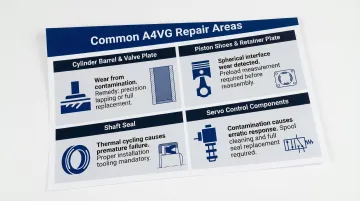
The most frequently serviced components in A4VG pump repair include:
Cylinder barrel and valve plate — wear from contamination or cavitation damages these precision-lapped surfaces, causing internal bypass and pressure loss. Repair involves surface inspection, lapping to restore flatness, or full replacement if wear exceeds tolerance.
Piston shoes and retainer plate — high-load cycling wears the spherical interface between pistons and shoes. Replacement requires careful measurement to confirm proper preload on the rotating group.
Shaft seal replacement — a routine wear item that fails from thermal cycling, case pressure spikes, or age. Replacement is straightforward but requires proper installation tools to avoid damage during fitting.
Servo control components — contamination or wear in solenoid valves and servo pistons causes erratic swashplate response, requiring disassembly, cleaning, and replacement of worn seals or spools.
Why Rexroth Tolerances Determine Rebuild Success
Incorrect preload on the rotating group or an improper valve plate surface finish causes immediate re-failure — the tolerances exist precisely because there is no margin for approximation in a high-pressure axial piston pump. Access to the official Rexroth A4VG service manual (RE 92003 for Series 32, RE 92004 for Series 40) and proper tooling is essential for in-house repair.
Professional Rebuild Advantages
Without a fully equipped hydraulic workshop, a certified rebuild facility is the reliable path to factory-spec performance. Hydrostatic Transmission Service rebuilds A4VG units to Rexroth specifications and backs every unit with a one-year warranty. Each rebuild is bench-tested across three critical parameters before returning to service:
- Charge pressure output under load
- Full-stroke displacement accuracy
- Case drain flow within manufacturer limits
This testing protocol catches reassembly errors before the pump reaches the machine — the most common cause of early re-failure in field-rebuilt units.
Conclusion
A4VG maintenance is not optional — it is the operating cost of running precision hydrostatic drive equipment reliably. A structured, hour-based approach to fluid quality, charge pressure monitoring, and timely overhaul protects both the pump and the broader hydraulic system from expensive failure.
When a pump has reached the point of major wear or failure, professional rebuild and exchange services offer a fast, guaranteed path back to full operation. Tested, warranted units cost less than new pumps and remove the guesswork from the repair process. Hydrostatic Transmission Service rebuilds and tests A4VG units to manufacturer specifications, backed by a 1-year warranty — so your equipment returns to service with confidence, not uncertainty.
Frequently Asked Questions
What is the most common cause of Rexroth A4VG hydraulic pump failure?
Hydraulic fluid contamination (particles above the pump's target ISO cleanliness level) and low charge pressure leading to cavitation are the leading causes. Both damage the cylinder barrel, valve plate, and piston shoes, creating internal bypass and pressure loss.
What is the life expectancy of a Rexroth A4VG hydraulic pump?
With proper maintenance — clean fluid, correct charge pressure, and timely filter changes — an A4VG can achieve 10,000 to 20,000 operating hours. Neglected units often fail before 5,000 hours, typically from contamination or inadequate charge pressure.
Is Bosch Rexroth the same as Bosch?
Bosch Rexroth is a subsidiary of the Bosch Group focused on industrial drive and control technologies, including hydraulics — a distinct entity from the consumer-facing Robert Bosch GmbH brand, which produces power tools and automotive components.
How often should hydraulic fluid be changed in an A4VG pump system?
Fluid changes are recommended at approximately 1,000–2,000 operating hours under normal conditions, but always guided by fluid analysis results. Contaminated or degraded fluid should be changed immediately to prevent accelerated pump wear.
What hydraulic fluid viscosity is recommended for the Rexroth A4VG?
The A4VG typically requires mineral hydraulic fluid in the ISO VG 46 or VG 68 range — VG 46 for moderate temperatures, VG 68 for higher operating environments. Confirm the correct grade against your pump variant's Rexroth data sheet before filling.
Can I rebuild an A4VG pump myself, or should I use a professional service?
A4VG rebuilds require precision tooling, a hydraulic test bench, and access to manufacturer tolerances — feasible for well-equipped shops but outside reach for most field crews. Professional rebuild services test and warranty the unit before return, which reduces the risk of repeat failures and unplanned downtime.