Introduction
Kawasaki hydraulic pumps—including the K3V, K5V, and K7V series—serve as the core power source for excavators, construction machinery, and agricultural equipment worldwide. Their performance directly determines machine uptime, operational efficiency, and the productivity of every job site they serve. When a Kawasaki pump operates at peak efficiency, actuators respond instantly, cycle times stay tight, and operators maintain full control under load.
Neglect tells a predictable story: progressive efficiency loss reduces machine performance before any visible symptoms appear, then unplanned downtime halts projects, then emergency repairs compound the damage. Full pump failure can sideline equipment for days or weeks, impacting project schedules and budgets.
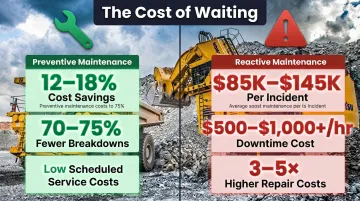
The numbers are stark. Reactive hydraulic pump repairs cost 3 to 5 times more than planned preventive maintenance, with heavy civil fleet hydraulic system failures averaging $38,000 per incident.
Avoiding those costs starts with knowing what to watch for and when to act. This guide covers the knowledge operators need to maintain Kawasaki hydraulic pumps effectively: maintenance types and when to apply them, early warning signs that demand immediate inspection, basic pressure adjustment procedures using the lock nut and adjusting screw method, and a practical maintenance schedule calibrated to operating hours and load conditions.
Key Takeaways
- Kawasaki hydraulic pumps require structured preventive maintenance to maintain performance and prevent costly failures
- Early warning signs—slow pressure response, unusual noise, oil contamination—should trigger immediate inspection
- Pressure adjustments using the lock nut and adjusting screw method fix minor performance issues before they worsen
- Maintenance schedules tied to operating hours and load conditions do more for pump lifespan than any single repair
- Internal wear or repeat failures call for a professional rebuild or exchange unit — not another round of patch repairs
Why Maintaining Your Kawasaki Hydraulic Pump Matters
Hydraulic pumps function as the heart of any hydraulic system. Pressure output and flow rate efficiency directly affect the speed, accuracy, and load capacity of every attached actuator. Even a 5–10% efficiency drop noticeably degrades machine performance—boom movements slow under load, bucket breakout force diminishes, and cycle times increase. Research shows that extreme valve plate damage can cause an 11% drop in volumetric efficiency, while severe wear conditions can push efficiency below 85% with maximum leakage rates exceeding 45 L/min.
The financial case for preventive maintenance is straightforward. Preventive programs yield 12–18% cost savings over reactive approaches and reduce equipment breakdowns by 70–75%. Routine service costs a fraction of emergency teardown or full pump rebuild. Construction equipment downtime alone runs $500 to $1,000+ per hour, which makes unplanned failures far more expensive than any scheduled service interval.
Pump failure also creates direct safety risks. Sudden loss of hydraulic control on a loaded excavator or combine can endanger operators and bystanders with no warning. Two regulatory frameworks govern this directly:
- ISO 4413:2010 — sets general safety requirements for hydraulic fluid power systems
- OSHA 29 CFR 1910.147 — governs lockout/tagout procedures required during servicing
Maintenance isn't just a cost decision. It's a compliance requirement and an operator safety obligation.
Types of Kawasaki Hydraulic Pump Maintenance
Not all maintenance is equal. The right maintenance type depends on the pump's operating environment, load cycle, and current condition. Kawasaki pumps in high-load excavator applications require more frequent attention than those in lighter-duty mobile machinery.
Preventive / Routine Maintenance
Routine preventive maintenance for Kawasaki pumps includes:
- Scheduled oil sampling and analysis to detect contamination before damage occurs
- Filter replacement at manufacturer-recommended intervals (typically every 1,000 hours)
- External visual inspections for leaks or physical damage
- Checking drain line back-pressure to ensure proper case drain function
- Verifying reservoir oil level and condition daily
Preventive maintenance is sufficient when pumps operate within rated pressure and speed with no abnormal symptoms. Typical costs are modest—hydraulic oil filter replacement runs approximately $50-150, while oil sampling costs $20-40 per sample. These small investments prevent catastrophic failures that cost thousands.
Corrective / Reactive Maintenance
Corrective maintenance is triggered by sudden pressure drop, failed components during operation, or warning signs that were missed. Relying primarily on reactive maintenance is costly because it almost always involves secondary damage to valve plates, cylinder blocks, or pistons by the time action is taken.
Emergency hydraulic repairs cost $85,000 to $145,000 per incident and account for 45% of excavator breakdowns. Contamination causes pistons to seize in bores, accelerates wear on swashblock and shoe faces, and degrades saddle bearings.
By the time operators notice performance problems, internal components typically require complete replacement—not simple adjustment.
Predictive / Condition-Based Maintenance
Condition-based maintenance uses oil contamination analysis (particle counts), pressure differential monitoring, and thermal imaging to predict failure before it occurs. Many Kawasaki K7V and K3VLS series pumps support pressure sensor monitoring that feeds into machine control systems, enabling continuous performance tracking.
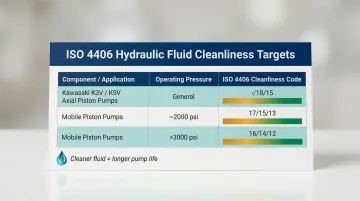
Kawasaki officially recommends maintaining fluid cleanliness at ISO 4406 -/18/15 or better for satisfactory service life. Predictive maintenance reduces unplanned downtime by 30–50% versus reactive operations and delivers a 10:1 to 30:1 ROI within 12 to 18 months for high-criticality assets.
ISO 4406 Cleanliness Targets:
| Component Type | System Pressure | Recommended ISO Code |
|---|---|---|
| Kawasaki K3V/K5V Axial Piston Pumps | General | -/18/15 |
| Mobile Piston Pumps | ~2000 psi (138 bar) | 17/15/13 |
| Mobile Piston Pumps | >3000 psi (207 bar) | 16/14/12 |
Major Overhaul / Rebuild Maintenance
Full overhaul is required when worn cylinder blocks, damaged valve plates, scored pistons, or internal leakage exceed acceptable limits—situations where field adjustments can no longer restore performance. When field repairs are no longer viable, exchange programs offer the fastest path back to operation.
Hydrostatic Transmission Service offers a Short-Time exchange program designed to minimize downtime: a rebuilt, tested replacement unit ships while the original pump undergoes full remanufacturing. Each unit is tested to OEM specifications and backed by a one-year warranty—getting equipment back to work days sooner than an in-house teardown allows.
Warning Signs Your Kawasaki Hydraulic Pump Needs Service
Kawasaki hydraulic pumps rarely fail without warning — catching early symptoms can mean the difference between a simple service call and a full pump replacement.
Pressure and Performance Issues
Slow actuator response is a primary early indicator. If boom, arm, or bucket movements become sluggish under load, the pump is likely losing volumetric efficiency (its ability to deliver rated flow) due to worn internal components or low charge pressure.
Distinguish between low-pressure and high-pressure slow action — this distinction is critical for the adjustment procedure covered later.
When the machine "holds" or drifts under pressure—where the actuator cannot sustain load at either low or high pressure—this indicates regulator or relief valve issues rather than mechanical wear. This symptom requires different diagnostic steps than simple efficiency loss.
Unusual Sounds, Vibration, or Behavior
Two acoustic and mechanical symptoms demand immediate attention:
- Cavitation noise (high-pitched whining or rattling) — signals insufficient inlet flow from a clogged suction filter, low reservoir level, or inlet restriction. Cavitation causes rapid erosion of valve plates and cylinder bores if not corrected immediately.
- Abnormal vibration or rhythmic pulsation — points to worn piston shoes, an imbalanced swash plate, or bearing failure. These symptoms intensify at higher pressures and speeds, helping narrow the diagnosis.
Fluid and Contamination Indicators
External oil leaks around the shaft seal, case drain port, or mounting flange signal internal pressure imbalance or seal degradation. The leak location matters: shaft seal leaks point to case drain back-pressure issues, while mounting flange leaks suggest internal pressure bleed-by.
Contaminated or discolored hydraulic fluid — milky, dark, or carrying metallic particles — indicates internal wear or water ingress. Kawasaki pumps are highly sensitive to oil cleanliness: particle contamination accounts for 82% of mechanical wear. Left unchecked, dirty fluid erodes valve plate and cylinder block surfaces, accelerating failure faster than almost any other single factor.

Basic Kawasaki Hydraulic Pump Adjustments and Repair Steps
This section covers field-adjustable repairs using the standard lock nut and adjusting screw method on Kawasaki piston pumps (K3V, K5V, and equivalent series). These are not full disassembly procedures.
Before starting: De-pressurize the system completely and consult the pump's service manual for torque specifications.
Low-Pressure Action Slow Fix
- Loosen the large lock nut (①)
- Turn adjustment nut (②) inward by 1/4 turn increments until operation normalizes
- Re-tighten the lock nut
Small incremental adjustments are critical to avoid over-pressurizing the low-pressure regulator circuit. Test operation between each adjustment to avoid overshooting the correct setting.
High-Pressure Action Slow Fix
- Loosen the small lock nut (③)
- Turn the square adjusting screw (④) inward by 1/4 turn increments until high-pressure operation normalizes
- Re-tighten the lock nut
This adjustment affects the high-pressure cutoff and should be verified against the machine's rated system pressure specification. Excessive adjustment can cause relief valve chatter or premature component wear.
Excavator Not Holding Load at Low Pressure
- Loosen large lock nut (①)
- Adjust nut (②) outward in 1/4 turn increments
- Re-tighten and test
Note the direction distinction—this adjustment moves opposite to the "slow action" fix because it reduces regulator spring preload rather than increasing it.
Excavator Not Holding Load at High Pressure
- Loosen small lock nut (③)
- Adjust square screw (④) outward
- Re-tighten and test
If this adjustment doesn't hold, inspect the relief valve and swash plate control mechanism for internal wear. Repeated failures to hold adjustment indicate damage beyond field repair — contact a professional rebuild service for evaluation.
Kawasaki Hydraulic Pump Maintenance Schedule
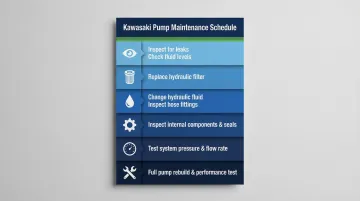
How often you service a Kawasaki hydraulic pump depends on three factors: operating hours, duty cycle, and working environment. A pump running continuous high-load cycles in an excavator needs a more aggressive schedule than one used intermittently in mobile equipment. The table below provides standard intervals — verify against your specific pump series' OEM manual before finalizing your schedule.
Maintenance Frequency Table:
| Interval | Maintenance Tasks |
|---|---|
| Daily / Per-Use | Check reservoir oil level; inspect for visible leaks; listen for cavitation or abnormal noise at startup |
| Every 500 Hours | Replace hydraulic tank breather; inspect all hydraulic lines and connections |
| Every 1,000 Hours | Replace filter elements; take oil sample for contamination analysis; check system pressure at rated RPM |
| Every 2,000 Hours | Full oil change (or per OEM spec); inspect shaft seals and case drain; check mounting bolts and coupling wear |
| Every 5,000 Hours | Full performance test (volumetric efficiency, pressure holdout); verify regulator and relief valve settings |
| Annual or Condition-Triggered | Evaluate for professional rebuild if volumetric efficiency has dropped or repeated pressure adjustments no longer hold |
Note on hydraulic breaker/hammer applications: Attachments like hydraulic hammers accelerate oil degradation. In those applications, change hydraulic oil at 1,500 hours rather than the standard 2,000–5,000-hour interval.
Frequently Asked Questions
What happens if you spin a hydraulic pump backwards?
Running a Kawasaki pump opposite to the rotation arrow on the housing stops correct flow, starves internal lubrication passages, and can immediately damage the cylinder block, valve plate, and shaft seal. Verify rotation direction before installation.
How long should a Kawasaki hydraulic pump last?
With proper maintenance, Kawasaki piston pumps (K3V, K5V, K7V series) typically last 5,000 to 10,000+ operating hours. Actual lifespan depends heavily on oil cleanliness, operating pressures, and whether preventive maintenance schedules are followed consistently.
Are Kawasaki hydraulic pumps good?
Kawasaki ranks among the top hydraulic pump manufacturers globally. Their K7V series achieves efficiency ratings 3+ percentage points above comparable pumps, and their pumps are OEM-specified for major excavator and construction machinery brands worldwide.
How do you maintain a Kawasaki hydraulic pump?
Key maintenance actions:
- Change oil and filters at OEM-recommended intervals
- Sample oil regularly to monitor contamination particle counts
- Check pressure and flow at rated speed
- Inspect for leaks, abnormal noise, and regulator drift
What are the most common failure points on a Kawasaki hydraulic pump?
The most frequent wear areas include valve plate and cylinder block surfaces (eroded by cavitation or contamination), shaft seals (failed from case drain back-pressure or age), piston shoes (worn from high load cycling), and the swash plate control mechanism (affected by regulator spring fatigue or contamination).
When should a Kawasaki hydraulic pump be rebuilt rather than repaired?
Field repair covers minor issues like seal replacement or pressure adjustment. When volumetric efficiency drops significantly, components show scoring, or repeated adjustments no longer hold, a full rebuild is the more reliable path. Hydrostatic Transmission Service offers rebuild-and-exchange programs with one-year warranties to minimize downtime.