Introduction
A failed skid steer hydraulic motor means one thing: the machine stops, and so does your job. Whether you're dealing with sluggish wheel response, grinding noises, or a complete loss of drive, the hydraulic motor is usually at the center of it.
The good news is that most failures follow recognizable patterns. Seal degradation, contamination, bearing wear, and maintenance neglect are the usual culprits — and most can be caught before they cause total loss.
This guide covers everything you need to make the right call:
- Recognizing early failure signs before they escalate
- Diagnosing root causes accurately
- Executing a step-by-step motor repair
- Deciding when professional rebuilding or an exchange unit beats DIY
Getting these decisions right protects your hydraulic system from secondary damage — and keeps downtime as short as possible.
Key Takeaways
- Five warning signs of a failing hydraulic motor: fluid leaks, unusual noise, drive refusal, power loss, and one-sided steering
- Most hydraulic motor failures are repairable if caught early; advanced internal damage typically requires a rebuild or replacement
- Fix the right way: confirm the symptom, isolate the root cause, replace worn seals/bearings/valve plates, then test under load
- Call a professional when you see internal metal damage, complete motor seizure, or a motor that keeps failing after repair
What Is a Skid Steer Hydraulic Motor?
A skid steer hydraulic motor converts hydraulic fluid pressure—delivered by the machine's pump—into mechanical rotation to drive the wheels or tracks. These motors operate under continuous load, pressure fluctuations, and exposure to debris, which gradually degrades internal components and triggers the need for repair.
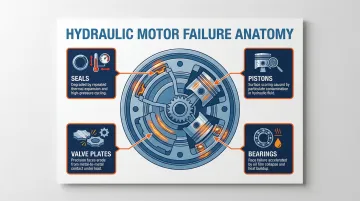
The components most vulnerable to wear include:
- Seals — degrade under heat and pressure cycling
- Pistons — prone to scoring from contaminated fluid
- Valve plates — wear at contact surfaces over time
- Bearings — fail when lubrication breaks down
Hydraulic motors generate torque through pressurized fluid moving through internal chambers—a mechanism that suits the high-torque, low-speed demands of skid steer operation. That same mechanism makes them vulnerable to three primary failure drivers: fluid contamination, heat buildup, and mechanical wear from continuous load cycles.
Common Signs Your Skid Steer Hydraulic Motor Needs Repair
Most hydraulic motor failures announce themselves through observable symptoms before total breakdown occurs. Recognizing these early prevents costly downstream damage to pumps, hoses, and other hydraulic components.
Fluid Leaks Around the Motor
Visible oil leaks indicate failed seals or worn bearings. Leaks are not just a fluid-loss problem — they allow contaminants like dirt, sand, and debris to enter the motor and accelerate internal wear. Even small leaks should be addressed immediately to prevent contamination from reaching pistons, valve plates, and other precision surfaces.
Excessive Noise or Unusual Vibration
Grinding, whining, or knocking sounds — paired with vibration — signal worn or failing bearings. The noise pattern helps identify the source: steady whining suggests bearing wear, while intermittent knocking points to loose or damaged internal components. Scored metal and broken bearing races cannot be repaired — those components require replacement.
Drive Refuses to Turn
A motor that won't rotate does not automatically mean the motor itself is failed. First check that:
- The parking brake is releasing fully
- Hydraulic fluid is actually reaching the motor
- Hose connections are secure and not blocked
- The charge pump is functioning
Only after ruling out these external issues should you condemn the motor unit.
Loss of Power or Reduced Performance
A skid steer that struggles on inclines, can't handle normal loads, or moves sluggishly points to one of three causes: low hydraulic pressure at the motor, an internal bypass leak, or a variable-speed motor stuck in high-speed mode (high speed = less torque).
Check hydraulic pressure at the motor port with a gauge and compare against manufacturer specifications. A significant drop confirms internal bypass or pump failure.
Skid Steer Pulling or Steering to One Side
This symptom typically indicates one motor is underperforming relative to the other. The pulling side identifies which motor is at fault. The fix is not steering calibration but motor inspection and service — unequal motor output cannot be corrected through control adjustments alone.
Why Skid Steer Hydraulic Motors Fail
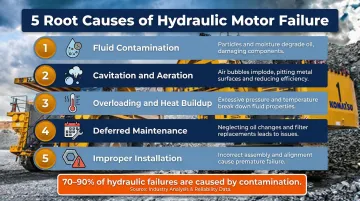
Four leading root causes account for the majority of hydraulic motor failures:
1. Hydraulic Fluid Contamination Particle ingress from broken seals, dirty filters, or poor maintenance scores internal surfaces and accelerates wear. Industry authorities consistently attribute 70% to 90% of all hydraulic system failures directly to fluid contamination.
2. Cavitation and Aeration Low fluid levels, clogged filters, or air entering the system cause pitting damage to pistons and valve plates. Cavitation starves the motor of fluid, creating vapor cavities that collapse and implode — producing a steady, high-pitched whine. Aeration, by contrast, pulls outside air into the suction side and produces a more erratic rattling noise.
3. Overloading and Heat Buildup Running beyond rated capacity or with insufficient cooling generates excessive heat that reduces fluid viscosity, accelerates seal failure, and causes thermal expansion that damages precision clearances.
4. Deferred Maintenance Skipping fluid changes, filter replacements, and routine inspections allows minor issues to compound into major failures. What begins as a leaking seal can cascade into contaminated fluid, scored valve plates, and bearing failure—transforming a $200–$500 seal replacement into a full motor rebuild or replacement costing several times more.
5. Improper Installation Cross-threaded ports, incorrect torque on housing bolts, and reversed hose connections are less obvious but real causes of premature failure — worth checking after any prior service work.
How to Repair a Skid Steer Hydraulic Motor: Step-by-Step
Attempting repair without first confirming the root cause wastes time and money. This process ensures the right components are addressed and the failure does not repeat.
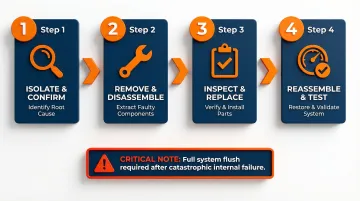
Step 1: Isolate and Confirm the Problem
Safety and Initial Inspection:
- Remove the skid steer from operation and relieve system pressure
- Perform a thorough visual inspection: look for external leaks, wet spots, and physical damage on the motor housing
- Check for contamination in the case drain line (visible metal particles indicate internal damage)
Pressure Testing: Check hydraulic pressure at the motor inlet using a gauge and compare against the manufacturer's specified operating pressure. According to Bosch Rexroth's hydraulic troubleshooting guidelines, case drain flow reaching approximately 10% of maximum output capacity signals excessive internal bypass leakage. At that point, the component requires a rebuild or replacement.
Step 2: Remove and Disassemble the Motor
Pre-Removal Process:
- Clean the surrounding area and motor exterior thoroughly to prevent introducing contaminants
- Tag or mark all hydraulic hoses before disconnecting so they can be reconnected to the correct ports
- Drain the motor completely and cap all open ports immediately
Disassembly Sequence:
- Remove the cover plate (note that some brands like Kayaba require specific tooling)
- Photograph parts and their orientation before removal
- Mark mating surfaces for correct reassembly
- Handle valve plates and bearing surfaces with extreme care, as they are lapped to precise tolerances
Step 3: Inspect and Replace Worn Components
Always Replace (Non-Reusable):
- All seals and gaskets; never reuse these
- OEM-spec seal kits are available for most major skid steer brands
Typically Replace Based on Wear:
- Bearings showing play, scoring, or rough rotation
- Pistons and valve plates with pitting, scoring, or uneven wear
- Gears and splines with pointed teeth or degraded spline profiles
Restoration Through Lapping: Some flat surfaces, such as valve plates, can be restored through lapping — a precision abrasive process — if the damage is not severe. This requires proper tooling and hands-on experience.
To gauge surface condition, run a fingernail across the sealing land. If you feel deep grooves, replace the part rather than attempt lapping. Only proceed if you have the right equipment and know the process well.
Step 4: Reassemble and Test
Once all worn components are replaced and lapped surfaces are within spec, reassembly can begin.
Reassembly Process:
- Follow alignment marks and reference photographs
- Apply correct torque specifications to all bolts
- Use appropriate thread-locking compound on critical fasteners
- Install all new seals with proper lubrication
Post-Repair Testing:
- Run the motor under no-load conditions first
- Monitor for leaks, abnormal noise, and vibration
- Test under normal operating load
- Verify full-range steering response
Critical: If a catastrophic internal failure caused the repair (e.g., metal debris in the system), a full hydraulic system flush is required before returning the machine to service. A fluid change alone is not sufficient.
Fix vs. Replace: Making the Right Call
The repair-vs-replace decision comes down to four factors: extent of internal damage, motor age and hours, parts and labor cost, and acceptable downtime. Use the table below to identify where your situation lands.
| Condition | Symptom(s) | Recommended Action |
|---|---|---|
| Leaking seals, no internal scoring | External fluid loss, no metal in fluid | Fix — Replace seals and gaskets. Straightforward repair that restores full function if caught before contamination spreads. |
| Worn bearings, no metal contamination | Noise, slight performance drop, clean fluid | Fix — Replace bearings and seals; inspect valve plate. Rebuild is viable if housing and rotating group surfaces are within spec. |
| Internal scoring, pitting, or metal particles in fluid | Sluggish output, heat, metal debris in filter | Rebuild or Replace — Metal damage compromises the entire rotating group. A full professional rebuild is required. Don't attempt DIY repair at this stage. |
| High hours, repeated failures, or repair cost near replacement cost | Recurring issues, escalating shop bills | Replace with a Rebuilt Exchange Unit — Continuing to repair a worn-out motor costs more long-term than swapping it out. |
When repair costs approach or exceed the price of a tested replacement, an exchange unit is the smarter call. Hydrostatic Transmission Service's Short-Time Exchange Program gets operators a professionally rebuilt, tested, and warranted unit fast—cutting downtime without the uncertainty of an extended shop repair. Every HTS rebuild is tested to manufacturer specifications using a Statistical Process Control System and backed by a 1-year warranty.
Preventive Maintenance to Avoid Future Failures
Improving fluid cleanliness by just one ISO code step can extend the life of pumps, valves, and bearings by 50% or more, making contamination control the single most effective preventive measure.
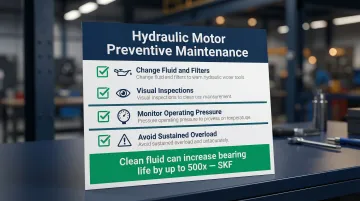
Key Preventive Actions:
- Change hydraulic fluid and replace filters at OEM-recommended intervals — contaminated fluid is the primary cause of internal wear
- Perform regular visual inspections of motor seals, hose connections, and case drain lines for early leak detection
- Monitor operating pressure at the motor and investigate deviations from spec immediately
- Avoid sustained overload or conditions that cause chronic overheating, which degrades seals and fluid rapidly
A small leak addressed promptly costs a fraction of what a contamination-driven bearing or valve plate failure costs in parts, labor, and downtime. SKF bearing data shows that clean fluid versus heavily contaminated fluid can increase bearing life by a factor of up to 500. That makes fluid maintenance the most cost-effective investment you can make in motor longevity.
Conclusion
Most skid steer hydraulic motor failures—leaks, noise, power loss—are fixable when identified early and addressed with a proper diagnosis-first approach. Correct root cause identification is the difference between a lasting repair and a repeat failure. Skipping diagnosis and replacing parts by guesswork is the most expensive mistake an operator can make.
When internal damage is too extensive for field repair, a professional rebuild or exchange is the fastest, most cost-effective path to getting the machine back to work. Hydrostatic Transmission Service specializes in exactly that—rebuilt and tested units backed by a one-year warranty, built to minimize downtime and get equipment back to full operation.
Frequently Asked Questions
Can hydraulic motors be repaired?
Yes, hydraulic motors can be repaired in many cases—particularly when the issue involves seals, bearings, or valve plates. However, motors with severe internal scoring or metal contamination typically require a professional rebuild or full replacement rather than a field repair.
How much does it cost to rebuild a hydraulic motor?
DIY seal replacement costs $200–$500 in parts, while professional rebuilds typically range from $1,500 to $4,000 depending on motor size, brand, and damage extent. Full replacement can exceed $5,000; remanufactured exchange units from specialized rebuilders often fall in the $1,500–$3,000 range and minimize downtime.
How to tell if a hydraulic motor is bad?
Key diagnostic indicators include fluid leaks at the motor, unusual noise or vibration during operation, failure to turn, loss of drive power, or one-sided steering. A pressure test at the motor inlet can confirm whether the motor or the supply circuit is at fault.
Why won't the hydraulics work on my skid steer?
Hydraulic system failure can stem from multiple sources: low fluid level, failed charge pump, clogged filters, a stuck relief valve, or a worn motor. Systematic diagnosis — checking fluid level, pressure, and pump output before condemning the motor — is essential.
What parts of a skid steer hydraulic motor wear out most often?
Seals and bearings are the most frequently replaced components, followed by valve plates and pistons in cases of contamination-related wear. Most major OEM brands — Eaton, Sauer Danfoss, Parker, and Rexroth — stock seal kits for common skid steer motors.
How long does a skid steer hydraulic motor last?
With proper fluid maintenance and early leak repair, motors can last 5,000–10,000 hours or more. Neglected maintenance can reduce that to under 2,000 hours — fluid cleanliness is the single biggest factor in extending motor life.