Introduction
When heavy equipment breaks down or starts underperforming, operators face a decision with real financial consequences: repair the faulty component, rebuild the entire system, or replace the machine altogether. The wrong call doesn't just waste capital — it stalls operations, drives unplanned downtime, and compounds safety exposure across your fleet.
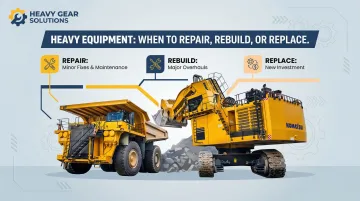
Each path carries different costs, timelines, and tradeoffs:
- Repair — addresses a specific failed component to restore basic function
- Rebuild — restores major systems across the machine to near-original performance
- Replace — procures new or used equipment with full warranties and updated capabilities
This guide covers the key factors, financial signals, and real-world scenarios that point toward the right call for your operation.
The right answer for a well-maintained excavator at 8,000 hours differs dramatically from a hydraulic system failing on a loader with 18,000 hours and a climbing repair history. Machine condition, operational demands, and remaining useful life all shape which path makes sense — and which one costs you more in the long run.
Key Takeaways
- Repair isolated failures when the machine is under warranty and you need it back online fast
- Rebuild when multiple systems need work and the machine still has strong resale or operational value
- Replace when repair costs repeatedly hit 50% of replacement value or new technology delivers clear operational gains
- Track cost-per-hour and lifecycle stage to anchor every decision
- Delaying or misreading these signals leads to compounding costs and unplanned downtime
Why Getting This Decision Right Matters for Your Bottom Line
Heavy equipment represents one of the largest capital investments in construction, agriculture, and industrial operations. Yet purchase costs account for only 15% to 20% of total ownership costs: the remaining 80% to 85% consists of fuel, maintenance, repairs, downtime, depreciation, and insurance.
The repair-rebuild-replace decision directly determines whether your investment generates returns or drains cash flow.
Excessive repairs on aging equipment and premature replacement of still-viable machines are both expensive mistakes. The financial damage of choosing wrong often exceeds the repair bill by a wide margin.
Downtime cost adds urgency to the equation. Every day a machine sits idle affects project timelines, productivity, and revenue:
- Construction equipment downtime costs $500 to $1,000+ per hour in direct and indirect losses
- Mining trucks can exceed $1,000 per hour in lost productivity
- Idle crews, missed schedules, equipment rentals, and contract penalties compound quickly
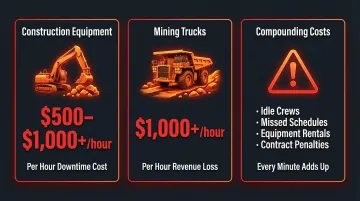
That's why timing matters as much as the decision itself — acting too late is its own cost.
The Key Factors That Drive the Right Choice
Warranty and Financial Status
Before evaluating anything else, check two things:
- Still under warranty? Most repair costs should be covered, making repair the obvious choice.
- Still making payments? A machine under financing changes the math significantly compared to a fully paid-off asset
These two factors alone can eliminate replacement as a viable option and narrow your decision to repair versus rebuild.
The 50/50 Rule as a Starting Threshold
The widely-used 50/50 rule provides a clear financial signal: if repair costs exceed 50% of the machine's current fair market value, replacement deserves serious consideration.
How repair costs escalate:
- Repair costs typically plateau at around 30% of replacement value
- The following year, they often jump sharply to 50%+ as additional systems fail
- When repair costs hit 30% of residual value, it's a mathematical indicator that serious evaluation is required
Treat the 50/50 rule as a planning signal, not an automatic trigger to replace — it indicates when to conduct formal lifecycle cost analysis.
Life-Cycle Cost Analysis (LCCA)
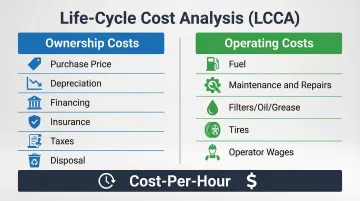
LCCA divides equipment economics into two categories:
Ownership Costs:
- Purchase price
- Depreciation
- Interest and financing
- Insurance
- Taxes
- Disposal
Once you've tallied ownership costs, stack them against what it actually costs to run the machine day-to-day:
Operating Costs:
- Fuel
- Maintenance and repairs
- Filters, oil, and grease
- Tires
- Operator wages
When operating costs consistently exceed what you'd pay to own and run a replacement machine, replacement wins on the numbers. Cost-per-operating-hour is the clearest metric for that comparison.
Example cost-per-hour benchmarks:
| Equipment Type | Hourly Rate |
|---|---|
| Caterpillar 330 GC Excavator (to 201 HP) | $150.99/hour |
| Caterpillar 395 Excavator (to 550 HP) | $336.18/hour |
| 190 HP 4WD Agricultural Tractor | $78.55/hour |
Track your actual cost-per-hour against these benchmarks to identify when a machine has crossed from economically viable to financially burdensome.
Machine Age, Hours, and Condition
Operating hours provide the primary indicator of where a machine sits in its lifecycle, but context matters. A well-maintained loader at 15,000 hours may outperform a neglected one at 8,000 hours.
Typical operating hour ranges for major service:
| Equipment Category | Service/Overhaul Trigger |
|---|---|
| Hydraulic Excavators | 7,000 to 10,000 hours |
| Wheel Loaders | 10 years or ~12,000 hours |
| Mini Excavators | 8,000 to 12,000 hours |
| Forklifts | 10,000 hours or 7-8 years |
Factors that affect true remaining useful life:
- Application intensity (extraction vs. light-duty work)
- Maintenance history and record-keeping
- Operator training and behavior
- Operating environment (dust, heat, moisture, contamination)
Within these broader timelines, hydraulic and hydrostatic systems tend to show wear signals earlier than most other components. They operate under constant high-pressure loads, piston pumps typically need service every 10,000 hours, and 75% to 85% of hydraulic failures trace back to fluid contamination — making fluid management one of the highest-leverage maintenance habits you can build.
Operational Needs and Technology Fit
Consider whether your existing machine can meet current and future job requirements:
- Power and capacity: Can it handle the workload you're bidding?
- Fuel efficiency: Modern excavators with smart hydraulics improve fuel efficiency by 30-40% compared to older models
- Technology upgrades: Would new telematics, load-sensing hydraulics, or automation unlock new contracts?
If operators are already productive on the existing machine and it handles your current workload, repair or rebuild is usually the more cost-effective path. But if newer equipment would cut operating costs by 30% or open bids you can't currently compete for, that changes the calculation entirely — run the numbers before deciding either way.
When to Repair, When to Rebuild, When to Replace
The right option depends on where the machine sits across three dimensions: scope of damage, remaining useful life, and financial picture. Here's a scenario-based breakdown.
When to Repair Heavy Equipment
Choose repair when:
- The problem is limited to one or two specific components
- The machine is under warranty or you still owe payments
- You need equipment operational quickly
- The failure doesn't indicate broader systemic wear
Repairs are the fastest and least expensive short-term fix for isolated failures. Field repair services—where technicians come to the job site—minimize transport time and further reduce downtime.
Repair is NOT the right answer when:
- Parts are discontinued or hard to source
- The same or related systems fail repeatedly
- The machine is so outdated that repairs can't address performance gaps
- You're treating symptoms without addressing underlying wear
When those conditions apply, repair becomes a short-term patch on a long-term problem — and that's where rebuilding starts to make financial sense.
When to Rebuild Heavy Equipment
Choose rebuilding when:
- Multiple systems need work simultaneously
- The machine has significant resale or operational value worth preserving
- Operators and workflows are already optimized around that specific machine
- You want like-new performance without the depreciation hit of purchasing new
A quality rebuild typically costs 50% to 60% of a new machine's price and can restore equipment to like-new performance for another 10,000+ hours. Most machines reach rebuild territory in the 12,000–15,000 operating hour range — though application type and maintenance history shift that window significantly.
Hydraulic and hydrostatic system rebuilds:
Hydraulic pumps, motors, and hydrostatic transmissions are among the most rebuild-worthy components on heavy equipment. They're expensive to replace new, well-suited to precision remanufacturing, and — when rebuilt to OEM specifications — perform identically to new units.
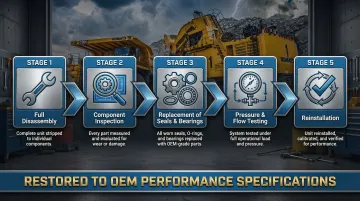
A hydrostatic transmission rebuild, for example, typically involves full disassembly, inspection of all wear components, replacement of seals and bearings, and testing against manufacturer pressure and flow specs before reinstallation. The result is a unit that meets original performance standards at a fraction of new-unit cost.
Rebuilding is NOT the right answer when:
- The machine's frame or structural components are compromised
- Operating hours far exceed the platform's design life
- Replacement parts for that model are no longer manufactured
- The cost of rebuilding multiple systems approaches or exceeds new equipment pricing
When to Replace Heavy Equipment
Sometimes neither repair nor rebuilding makes sense. Replacement becomes the right call when the machine has exhausted its useful life or when the cost and downtime of restoration outweigh the value returned.
Choose replacement when:
- Total repair or rebuild costs exceed 60–70% of the machine's current market value
- The platform is technologically obsolete and affects productivity or compliance
- Structural damage (frame cracks, chassis failure) makes restoration unsafe or impractical
- Repeated failures across multiple systems signal end-of-life wear
- Parts availability has dried up, making future maintenance unpredictable
Replacement also makes sense when updated equipment delivers meaningful efficiency gains — fuel economy, operator safety features, telematics — that a rebuild can't replicate.
One important distinction: replacing the full machine doesn't always mean replacing every component. Hydrostatic transmissions, hydraulic pumps, and drive motors can often be transferred, rebuilt, or exchanged — preserving value from the old unit even as the platform itself is retired.