Introduction
The hydraulic pump is the heart of your skid steer's power system. It drives the lift arms, powers attachments, and moves the machine across the jobsite. When this critical component begins to fail, productivity grinds to a halt—and the financial impact extends far beyond the repair bill itself.
Ignoring early warning signs costs $500 to $1,000+ per hour in lost productivity, idle crews, and emergency replacement equipment. Reactive maintenance can add over $100,000 in lifecycle costs compared to proactive service.
What starts as a manageable seal leak or minor pressure loss can cascade into catastrophic internal damage—forcing emergency repairs at 150–200% cost premiums.
This guide covers:
- How to recognize pump failure early
- What the rebuild process involves
- How to compare rebuild, replace, and exchange options
- Maintenance practices that stop failures before they start
Key Takeaways
- Most skid steer hydraulic pumps can be rebuilt to OEM performance at 40–60% the cost of replacement
- Watch for pressure loss, sluggish operation, whining or knocking sounds, overheating, and visible leaks
- Professional rebuilds cover disassembly, precision measurement, parts replacement, and testing to manufacturer specs
- Contaminated hydraulic fluid causes 70–80% of all pump failures—routine fluid checks prevent most failures
- Exchange programs ship a tested, warranted rebuild immediately — minimizing downtime while yours is serviced
Warning Signs Your Skid Steer Hydraulic Pump Needs a Rebuild
Catching pump problems early is the difference between a cost-effective rebuild and a full replacement. A pump showing early symptoms can often be restored — a severely damaged unit may take related components down with it, turning a $500 repair into a $3,000 system overhaul.
Loss of Hydraulic Pressure or Sluggish Performance
Reduced lift speed, slower bucket curl, or weak auxiliary hydraulic response all signal internal wear. As gears or pistons deteriorate, the pump loses volumetric efficiency — the percentage of theoretical flow actually available to do useful work. According to Bobcat service manuals, if high-pressure flow drops below 80% of free flow, the pump requires rebuild or replacement.
This gradual power loss happens because internal clearances have opened up, letting pressurized fluid bypass internally instead of driving the work circuit. The machine still runs — it just can't keep up.
Unusual Noises: Whining, Knocking, or Cavitation
A high-pitched whine typically indicates cavitation — the pump is starved for fluid, creating vapor bubbles that collapse violently on the discharge side. These implosions generate localized temperatures up to 5,000°F, causing severe pitting on thrust plates and internal components.
Knocking or grinding sounds point to damaged bearings, pistons, or the rotating group. Cavitation is destructive and compounds fast if you don't address the root cause immediately. Common causes include:
- Low fluid level in the reservoir
- Restricted suction line or clogged strainer
- Excessively high oil viscosity in cold conditions
- Contaminated fluid creating blockages
Overheating and Fluid Discoloration
Excessive heat beyond normal operating range is a classic sign of pump inefficiency. Worn internal clearances cause fluid to bypass internally, generating heat without doing useful work. Every 10°C (18°F) increase in operating temperature halves the oxidation life of the fluid, accelerating varnish buildup and valve sticking.
Visual fluid inspection provides immediate diagnostic clues:
| Fluid Appearance | Root Cause | System Impact |
|---|---|---|
| Milky or creamy | Water contamination | Additive depletion, corrosion, reduced film thickness |
| Dark or burnt smell | Thermal degradation | Varnish buildup, valve sticking, accelerated oxidation |
| Cloudy | Aeration or cavitation | Erratic operation, loss of lubrication, metal erosion |
External Fluid Leaks
Leaks around shaft seals, end caps, or port fittings indicate seal deterioration — a common and repairable pump issue. Allowing leaks to persist introduces air into the system, compounding internal damage through aeration and cavitation. Small external leaks often signal that internal seals are degrading in parallel; catching them early typically means a seal kit fixes the problem rather than a full rotating group replacement.
The Skid Steer Hydraulic Pump Rebuild Process: Step by Step
Skid steers use two main pump types:
- Gear pumps — simpler design, common in older or smaller machines for implement circuits
- Tandem piston pumps — higher pressure, more complex, used in modern machines for drive systems
The rebuild process follows similar principles for both, but varies considerably in complexity and required expertise.
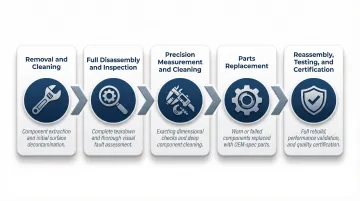
Step 1 — Removal and External Cleaning
After relieving hydraulic pressure and draining fluid, the pump is safely removed from the machine. External cleaning before disassembly is critical—it prevents dirt, debris, and contamination from entering internal components during the rebuild process. Technicians pressure-wash the exterior and remove accumulated grime that could compromise the rebuild.
Step 2 — Full Disassembly and Initial Inspection
A trained technician fully disassembles the pump, cataloging every component. Seals and O-rings are automatically flagged for replacement regardless of condition. Visual inspection looks for:
- Scoring or pitting on cylinder barrels and pistons
- Cracking in the pump housing
- Corrosion on internal surfaces
- Wear patterns that indicate the root cause of failure
This diagnostic step determines whether the pump is rebuildable or requires replacement.
Step 3 — Component Cleaning and Precision Measurement
All metal components are cleaned in a parts washer to remove debris, varnish, and sludge. After cleaning, critical components—shaft, barrel, pistons, port plate, gears—are measured against OEM tolerances using precision instruments. Parts that fall outside manufacturer specifications are flagged for replacement.
Step 4 — Replacement of Worn and Non-Reusable Parts
Seals, O-rings, and bearings are always replaced in a proper rebuild, regardless of appearance. Shaft journals, pistons, or gear sets showing wear beyond specification are replaced with new or reconditioned parts. Using substandard replacement parts is a common cause of rebuild failure—quality components machined to OEM tolerances are essential for longevity.
Step 5 — Reassembly, Testing, and Certification
The pump is reassembled to correct torque specifications, then run on a dedicated hydraulic test bench to verify:
- Flow rate (GPM) at specified RPM
- Maximum operating pressure (PSI)
- Volumetric efficiency (internal leakage)
- Case drain flow (indicating internal bypass)
A pump rebuilt and tested to these specs performs equivalently to a new unit. Hydrostatic Transmission Service backs every rebuild with a 1-year warranty and uses a Statistical Process Control System to validate quality data against manufacturer specifications before any unit ships.
Rebuild, Replace, or Exchange: Costs and Considerations
When a pump fails, skid steer owners face three decision paths: rebuilding the existing pump, purchasing a new OEM or aftermarket pump, or using an exchange/reman program. Cost, downtime, and severity of damage all factor into the best choice.
When a Rebuild Makes Sense
Rebuilding is the most cost-effective option when damage is limited to seals, bearings, and wear components rather than structural housing damage. Typical rebuild costs:
| Pump Type | Rebuild Cost Range | New Pump Cost Range |
|---|---|---|
| Gear pumps | $150 – $1,200 | $200 – $2,500 |
| Tandem piston pumps | $800 – $7,500 | $1,500 – $15,000+ |
Rebuilding typically costs 40-60% of new replacement, making it attractive for expensive tandem piston pumps common in modern skid steers from Bobcat, Case, John Deere, and New Holland.
When Replacement Is the Better Option
Replacement is more practical when:
- The pump housing is cracked or scored beyond salvage
- The pump is an older/discontinued model with unavailable parts
- Rebuild costs approach or exceed 60-70% of new unit cost
- Catastrophic failure has destroyed multiple components
For gear pumps, which are relatively inexpensive, replacement often makes more sense than extensive rebuild work.
The Exchange Program Advantage: Minimizing Downtime
Exchange/reman programs ship a fully rebuilt, tested, and warranted unit to you immediately, allowing you to get back to work while your failed pump is being rebuilt. Hydrostatic Transmission Service offers a Short-Time Exchange Program backed by a 1-year warranty. Each unit is rebuilt and tested to manufacturer specifications using a Statistical Process Control System. Rather than waiting days or weeks for your pump to be rebuilt, you receive a tested replacement unit fast, minimizing the $500-$1,000+ per hour cost of equipment downtime.
Hidden Costs to Factor Into Your Decision
When comparing options, account for total cost of downtime—not just parts prices. Lost productivity, rental equipment, idle labor, and missed deadlines often dwarf the price difference between rebuild and replacement. If your machine is generating revenue, the right benchmark isn't rebuild cost versus exchange cost—it's either option versus another day of lost production.
Preventing Future Pump Failure: Maintenance Tips and Schedule
Most skid steer hydraulic pump failures are preventable. Contaminated fluid causes 70-80% of all hydraulic component failures — and a consistent maintenance schedule stops that contamination before it reaches your pump.
Key Preventive Practices
Three practices matter most:
- Use the correct hydraulic fluid grade and change it per manufacturer specs — typically every 1,000 hours
- Replace hydraulic filters on schedule — every 500 hours standard, every 100 hours in dusty conditions, and after any contamination event
- Inspect suction lines and reservoir breathers regularly to block air ingestion and particulate entry
Maintenance Frequency Table
| Interval | Maintenance Tasks |
|---|---|
| Daily / Per-Shift | Check fluid level, inspect for visible leaks, listen for abnormal noise |
| Every 250 Hours | Inspect filter condition, check fluid sample for contamination/discoloration |
| Every 500–1,000 Hours | Full hydraulic fluid change, filter replacement, hose inspection |
| Annual / As Needed | Full system pressure check, pump case drain flow test to detect internal bypass |
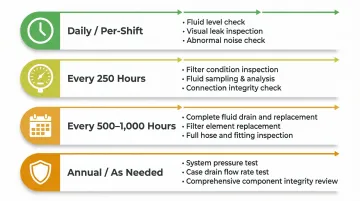
Harsh operating environments — high dust, heat, or moisture — compress these intervals considerably. Fluid analysis every 250 hours is worth adding to any schedule: it catches metal particle buildup, water intrusion, and viscosity breakdown before any of them reach the pump.
Conclusion
Skid steer hydraulic pump rebuilds, when done correctly with quality parts and tested to OEM specifications, restore full machine performance at a fraction of the cost than replacement. The key to a successful rebuild is catching failure symptoms early—before internal damage becomes catastrophic.
When a rebuild or exchange is needed, the specialist you choose matters. Hydrostatic Transmission Service backs every rebuild with OEM-spec testing, a 1-year warranty, and a short-time exchange program designed to get your machine back to work fast. With over 100 years of combined experience across hydraulic and hydrostatic systems, the team has the diagnostic depth to do the job right the first time.
Proactive maintenance pays. Catching a failing pump early costs a fraction of what full internal damage — and the downtime that follows — will run you.
Frequently Asked Questions
Can a skid steer hydraulic pump be rebuilt?
Yes, most skid steer hydraulic pumps—including gear pumps and tandem piston pumps—can be rebuilt as long as the housing is structurally sound and replacement parts are available. A proper rebuild by a qualified shop restores the pump to OEM performance specifications.
How much does it cost to rebuild a skid steer hydraulic pump?
Costs vary based on pump type and damage extent. Gear pump rebuilds typically range from $150 to $1,200, while tandem piston pump rebuilds cost $800 to $7,500. Rebuilding is typically 40-60% the cost of new replacement.
What causes skid steer hydraulic pump failure?
The most common causes are fluid contamination (dirt, debris, water), cavitation from low fluid levels or restricted suction lines, overheating due to worn internal clearances, and neglected seal or filter maintenance. Contamination alone accounts for 70-80% of all hydraulic failures.
How long does a skid steer hydraulic pump rebuild take?
A standard rebuild at a professional shop typically takes 3–7 business days, covering disassembly, inspection, parts sourcing, reassembly, and testing. Short-time exchange programs eliminate most of that wait by providing a ready-to-install rebuilt unit immediately.
How long does a rebuilt skid steer hydraulic pump last?
A properly rebuilt pump using quality replacement parts and tested to OEM specifications can match the service life of a new pump. Gear pumps typically last 5,000-10,000 hours, while piston pumps last 15,000-20,000+ hours—depending on fluid cleanliness and adherence to maintenance schedules.
What is the difference between rebuilding and remanufacturing a hydraulic pump?
Rebuilding restores a specific unit using a mix of original and new components to return it to working condition. Remanufacturing involves complete disassembly, standardized replacement of all wear parts, and certified performance testing, typically carrying broader warranties and same-as-new performance guarantees.