Key Takeaways
- Reconditioned hydraulic and hydrostatic motors typically cost 35–50% less than new OEM units
- Final price depends on motor type, displacement, brand, and severity of internal wear — a quote requires inspection
- Exchange programs deliver the fastest turnaround, minimizing costly equipment downtime
- Low-cost rebuilds often carry hidden costs — factor in warranty coverage, testing standards, and failure risk before deciding
How Much Does a Reconditioned Motor Cost?
Reconditioned hydraulic and hydrostatic motor pricing does not follow a single fixed price—it depends on motor type, size, brand, rebuild scope, and whether you use an exchange program or direct repair service.
Operators who misunderstand cost face three common problems:
Operators who misunderstand cost face three common problems:
- Underbudgeting for core charges and shipping
- Choosing a low-cost rebuild that fails prematurely
- Overlooking downtime costs during lengthy repair turnarounds
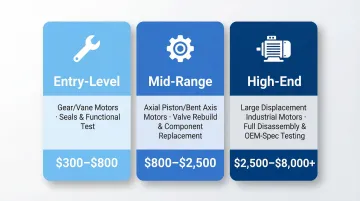
Pricing generally falls into three tiers based on motor type and rebuild scope:
| Tier | Motor Type | Rebuild Scope | Typical Price Range |
|---|---|---|---|
| Entry-Level | Gear or vane motors | Seals, inspection, functional test | $300–$800 |
| Mid-Range | Axial piston or bent axis motors | Valve rebuild, precision measurement, worn component replacement | $800–$2,500 |
| High-End | High-displacement / high-pressure industrial motors | Full disassembly, re-machining, barrel/piston kit, OEM-spec testing | $2,500–$8,000+ |
Entry-Level / Light-Duty Motors
This tier covers smaller gear or vane motors used in light-duty hydraulic circuits. These simpler designs typically include basic inspection, seal replacement, and tested operation. Pricing at this tier does not cover extensive machining or internal component replacement such as pistons or barrel kits.
A practical choice for lower-pressure applications, older equipment, or situations where minimizing upfront cost takes priority.
Mid-Range / Standard Piston or Axial Motors
This tier covers axial piston and bent axis motors used in agricultural, construction, and material handling equipment from brands like Sauer Danfoss, Eaton, and Parker. Rebuilds include valve work, precision measurement to manufacturer tolerances, and replacement of worn internal components.
The right fit for operators running equipment regularly who need reliable performance and warranty coverage without OEM new-unit pricing.
High-End / Large Displacement or High-Pressure Industrial Motors
This tier covers high-displacement, high-pressure hydrostatic motors used in heavy industrial or specialized equipment. These rebuilds involve full disassembly, precision re-machining, replacement of barrel and piston kits, and comprehensive testing to manufacturer specifications. The rebuild process mirrors OEM remanufacturing standards.
Built for high-utilization equipment where reliability is non-negotiable and downtime carries serious cost consequences.
Key Factors That Affect the Cost of a Reconditioned Motor
Reconditioned hydraulic and hydrostatic motor pricing varies widely — driven by motor type, internal condition, brand specs, and how fast you need the unit back. Knowing what moves the number helps you evaluate quotes accurately and avoid surprises.
Motor Type and Configuration
Motor type drives cost significantly:
- Gear motors: Simplest design, lowest rebuild cost due to fewer precision components and higher tolerance for contaminated fluid
- Vane motors: Moderate complexity requiring careful sizing and replacement of vanes, cam rings, and seals
- Piston motors (axial/radial): Highest complexity, engineered for extreme pressures exceeding 400 bar, requiring precise rebuild of swash plates, cylinder blocks, and pistons
More complex configurations demand more skilled labor, tighter tolerances, and higher-quality replacement components—all of which increase cost.
Size, Displacement, and Pressure Rating
Larger displacement motors and those rated for higher operating pressures require more material and more precise rebuild work, directly increasing cost. A high-pressure motor subjected to continuous heavy loads will show greater internal wear during teardown, expanding the scope of reconditioning needed compared to a motor used intermittently at lower loads.
Brand and OEM Specifications
Motors from major OEMs—Sauer Danfoss, Eaton, Parker, Rexroth Bosch, Hydreco—often require brand-specific parts to meet manufacturer tolerances. This affects both parts cost and which rebuild facilities are qualified to service them.
Genuine OEM parts vs. aftermarket: Parker's "Keep it REAL" program emphasizes that using market parts from unknown manufacturers provides no assurance of performance. Only genuine parts used by authorized repair centers ensure the product is repaired to exact original configuration and performs the same as new. Generic or aftermarket-spec rebuilds cost less but may not restore original performance.
Condition of the Core Unit
The extent of internal damage discovered during teardown is the most unpredictable cost driver. A motor with worn seals and mild bore wear costs far less to recondition than one with scored pistons, damaged barrel kits, or cracked valve plates.
Important: Pre-teardown estimates can shift once the unit is opened. Technicians may discover internal erosion, valve seat damage, manifold cracks, or wear patterns not visible externally—any of which can increase the rebuild scope and cost.
Turnaround Method: Repair vs. Exchange Program
Two service paths carry different cost and time implications:
| Direct Repair | Exchange Program | |
|---|---|---|
| How it works | Send in your failed unit; it's rebuilt and returned | A pre-rebuilt unit ships immediately |
| Cost | Lower upfront cost | Premium pricing, but includes speed |
| Downtime | Longer — wait for teardown, rebuild, and return shipping | Minimal — unit arrives before yours is rebuilt |
| Core deposit | Not required | Required; refunded when your core is returned |
| Best for | Budget-sensitive situations with flexible schedules | High-value equipment where every idle day has a cost |
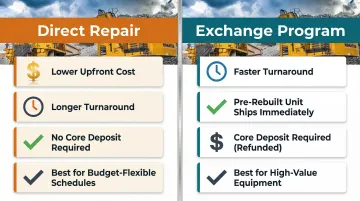
For most industrial operations, the math favors exchange programs: a single day of unplanned downtime on a production line or heavy equipment typically costs more than the exchange premium itself.
What's Included in the Cost: A Full Breakdown
The unit price is only part of the total cost picture. Several additional line items can quietly push the real investment well above the quoted price.
One-Time Costs:
- Reconditioned unit price: Base cost for the rebuilt motor itself
- Core charge/deposit: Refundable once you return your failed unit under an exchange program
- Freight (both directions): Costs to ship your core out and receive the rebuilt unit back
- Packaging materials: Proper crating to prevent damage during transit
- Installation labor: Technician time to pull the failed motor and mount the replacement
- Hydraulic system flush: Necessary after installation to clear contaminants that triggered the original failure
Recurring and Periodic Costs:
- Hydraulic fluid and filter maintenance: Ongoing costs to protect the rebuilt motor from premature wear
- Future rebuild or replacement: Eventual cost at end of next service life
- Warranty coverage: A 1-year warranty offsets repair costs if the unit fails early — something no-warranty alternatives won't cover
Reconditioned vs. New Motor: Which Makes More Sense?
A new OEM motor offers factory-fresh tolerances and the longest warranty but at the highest upfront cost. A quality reconditioned motor, rebuilt and tested to manufacturer specifications, can deliver comparable performance at substantially lower cost. The better choice depends on your equipment's age, how hard it runs, and what replacement actually costs you.
Performance and Precision
A quality reconditioned motor—one that is fully disassembled, measured against OEM specifications, re-machined where needed, and tested before shipping—performs comparably to a new unit.
What defines quality:
- Complete teardown and inspection of all components
- Measurement and calibration to manufacturer specifications
- Replacement of worn internal components (seals, bearings, piston kits, barrel assemblies, valve plates)
- Re-machining to restore tolerances
- Dynamic end-of-line testing under load
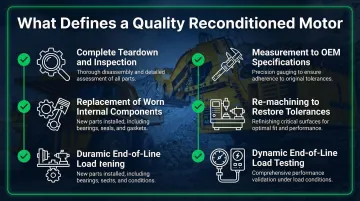
OEM remanufactured motors must pass the exact same performance tests as brand-new units, ensuring they meet or exceed original specifications.
Low-cost rebuilds that replace only seals and reuse worn internals typically fall short of original performance specs — a meaningful distinction when equipment downtime is expensive.
Durability and Warranty
Rebuild quality directly determines lifespan. Motors rebuilt with new internal components (piston kits, barrel, valve plate) and tested under load can achieve service life approaching that of new units. Partial rebuilds using worn parts carry higher risk of early failure.
Reputable rebuilders back their work with warranties. Hydrostatic Transmission Service, for example, offers a 1-year warranty on all rebuilds and validates every unit against manufacturer specifications using a Statistical Process Control System — ensuring each motor ships in properly functioning condition.
OEM remanufactured motors carry warranties that match new units—Parker offers 18 months, Danfoss offers 18 months, and Bosch Rexroth offers 18–24 months. Warranty length is a practical signal of how much a rebuilder trusts their own work.
Long-Term Value
For equipment with remaining useful life, a quality reconditioned motor often delivers the best balance of cost, reliability, and speed of return to service. Exchange programs make this especially practical: pre-rebuilt units ship immediately, skip the repair queue, and cost significantly less than new OEM pricing. When downtime costs are factored in, the total cost of ownership usually favors a quality rebuild.
When a reconditioned motor makes the most sense:
- Equipment has significant remaining service life
- Replacement cost for new OEM units is high
- Downtime costs make waiting for direct repair impractical
- A short-turn exchange unit is available and ready to ship
What Most Buyers Get Wrong About Reconditioned Motor Costs
Focusing Only on the Unit Price
Many operators compare only the sticker price of reconditioned options without factoring in core charges, freight costs, and the value of warranty coverage. The lowest-quoted rebuild often costs more in total when all variables are accounted for.
Hidden costs that add up:
- Core deposits that tie up capital until your failed unit is returned
- Inbound and outbound shipping charges
- Packaging and crating fees
- Installation labor
- Hydraulic system flushing and fluid replacement
- Risk of early failure without warranty coverage
Underestimating the Cost of Downtime
In industrial, agricultural, or construction applications, a motor failure that takes equipment out of service for days or weeks has a real cost in lost productivity.
Unplanned downtime costs an average of $260,000 per hour in industrial settings. For construction equipment, Ajax Paving Industries factors downtime costs at $234 per minute—equating to $112,000 per day for a single asphalt paver.
Failing to weigh turnaround time as a cost factor means buyers often choose the slower path—even when faster options would more than pay for the price difference.
Choosing Quality Based on Price Alone
The cheapest rebuild isn't always the best value. Without knowing whether a shop tests to manufacturer specifications, replaces worn internals, or backs its work with a warranty, you're taking on significant risk.
What to verify before committing:
- Does the rebuilder perform complete disassembly and inspection?
- Are worn internal components replaced or just seals?
- Does the rebuilder test the motor under load to manufacturer specifications?
- What warranty coverage is included?
- Does the rebuilder use genuine OEM parts or generic aftermarket components?
A motor that fails within months requires the full cost to be spent again, plus additional downtime. Initial acquisition cost typically represents less than 10% of total cost of ownership, while reliability and maintenance costs drive five times more of the total cost.
Frequently Asked Questions
How much does a reconditioned motor cost?
For hydraulic and hydrostatic motors used in industrial or heavy equipment applications, reconditioned unit pricing varies based on motor type, size, and brand. Industry data shows savings of 35-50% compared to new OEM units. Exchange programs may carry a core charge in addition to the unit price, refundable upon return of the failed unit.
Is it cheaper to rebuild a motor or buy new?
In most cases, yes. Bosch Rexroth reports customers save up to 50% using remanufacturing services, while Danfoss cites savings up to 35%. For high-utilization equipment, a properly rebuilt unit tested to manufacturer specs delivers comparable performance at a fraction of the new OEM price.
Is a reconditioned motor worth it?
Yes, provided it comes from a qualified rebuilder, is tested to manufacturer tolerances, and carries a warranty. New OEM units typically cost two to three times more for the same performance.
What is included in a reconditioned motor?
A quality reconditioned motor typically includes:
- Disassembly and full inspection
- Replacement of worn seals, bearings, and piston kits
- Re-machining to restore manufacturer tolerances
- Reassembly and performance testing
Confirm whether genuine OEM parts are used and what warranty applies before committing.
How long does a reconditioned hydraulic motor last?
Service life depends on rebuild quality, operating conditions, and maintenance. A motor fully rebuilt to manufacturer specifications with new internal components can last as long as a new unit. Partial rebuilds that reuse worn parts typically have shorter service life and higher risk of premature failure.
What is the difference between a reconditioned and remanufactured motor?
"Reconditioned" refers to restoring a used motor to working condition by replacing worn parts. "Remanufactured" describes a more comprehensive process that returns the unit to original OEM specifications using new components throughout. Quality standards and warranty coverage are generally stronger for remanufactured units.