
Introduction
A skid steer losing drive mid-pour. A combine crawling through a field at harvest. A forklift that barely moves under load. When hydrostatic transmission failure hits, the question isn't whether it costs money — it's how much, and how fast you can get back to work.
HST problems rank among the most common and costly failures in agricultural, construction, and material handling equipment. According to Hydro-Gear service documentation, the majority of HST failures follow predictable patterns: low fluid, contaminated oil, air in the system, clogged filters, or internal pump wear. Most of these issues can be diagnosed and resolved before they escalate to full transmission failure.
This guide covers the most common HST problems and their symptoms, a step-by-step troubleshooting and repair process, and clear criteria for when to repair versus when to replace or rebuild your transmission.
Key Takeaways
- Most hydrostatic transmission failures stem from low fluid, clogged filters, air entrainment, worn seals, or internal pump/motor damage
- Many issues resolve with fluid checks, filter replacement, system purging, or seal repair—often DIY-viable
- Internal failures—worn pistons, cylinder barrels, or a failed charge pump—typically require a professional rebuild or unit exchange
- Catching symptoms early (whining, sluggish movement, overheating) prevents accelerating damage and higher repair costs
What Is a Hydrostatic Transmission?
A hydrostatic transmission (HST) is a closed-loop hydraulic system that uses pressurized fluid—rather than gears or belts—to transmit power from the engine to the wheels or tracks. The engine drives a variable-displacement hydraulic pump, which sends high-pressure fluid to a hydraulic motor that turns the axle.
By changing the angle of the pump's swashplate, you control both speed and direction without shifting gears or using a clutch.
Core components include:
- Variable-displacement pump that controls fluid flow volume and direction
- Fixed-displacement motor that converts fluid pressure into rotational force
- Charge pump that maintains system pressure and prevents cavitation
- Control valve/center section that routes fluid between pump and motor
- Fluid reservoir and filter that store and clean hydraulic fluid
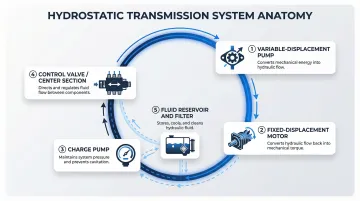
Because every component is precision-machined, the system is only as reliable as its weakest part. Fluid breaks down, contaminants accumulate, seals wear, and internal components degrade under mechanical stress—which is exactly why understanding your HST's anatomy makes troubleshooting faster and more accurate.
Common Hydrostatic Transmission Problems
Most hydrostatic transmission failures present through a consistent set of symptoms. Knowing which symptoms point to which causes cuts diagnostic time and gets equipment back in service faster.
Low Fluid Level or Fluid Contamination
Symptoms:
- Sluggish or weak drive response
- Overheating transmission housing
- Whining or cavitation noise from the pump
- Erratic speed or loss of power under load
Likely cause: Fluid loss through leaking seals, hose connections, or shaft seals. Contaminated fluid from water ingress, metal particles from internal wear, or incorrect fluid type degrades pump and motor performance rapidly. John Deere technical documentation warns that oil that is too thin causes increased wear, excessive internal leakage, and loss of pressure.
Clogged or Bypassed Hydraulic Filter
Symptoms:
- Reduced power or drive response that worsens under load
- System overheating
- Sluggish operation in both forward and reverse
Likely cause: Filters neglected past their service interval become restricted, reducing fluid flow and forcing the system to work harder. Some systems bypass the filter entirely when clogged — sending dirty fluid straight through the circuit and accelerating internal wear.
Air in the Hydraulic System
Symptoms:
- Jerky or inconsistent movement
- Loss of drive after storage or fluid service
- Spongy pedal feel
- Unusual gurgling sounds from the transmission
Likely cause: Air enters the system during fluid changes, through seal failure, or after equipment has been stored with low fluid. Hydro-Gear service manuals link trapped air to noisy operation, severe power loss after short operation, and excessive oil expansion/overheating.
Internal Pump or Motor Wear
Symptoms:
- Gradual or sudden loss of power and drive speed
- Inability to maintain speed under load
- Loud grinding or whining noise
- Heat buildup in the transmission housing
Likely cause: Worn pistons, barrel bores, or bearing surfaces inside the hydraulic pump or motor. This typically results from extended operation with low or contaminated fluid, overloading, or exceeding the equipment's rated capacity.
How to Fix Hydrostatic Transmission Problems – Step by Step
Attempting to fix a hydrostatic transmission without first confirming the root cause wastes time and risks further damage. Follow these steps in sequence to isolate the exact problem before applying any fix.
Step 1: Identify the Exact Problem
Check fluid level and condition first:
- Verify fluid is at the correct level on the dipstick or sight glass
- Inspect fluid color and smell—dark, milky, or metallic-flecked fluid signals serious internal damage
- Clean fluid should be amber or light brown; milky fluid indicates water contamination
Look for external leaks:
- Inspect all hose connections, fittings, and shaft seals
- Note whether the tractor moves at all, moves but loses power under load, moves erratically, or produces abnormal sounds
Document when the problem occurs:
- At startup, after warming up, continuously, or only under load
- This pattern helps distinguish fluid/filter issues from internal wear
Step 2: Address Fluid, Filter, and Air Issues First
Replace hydraulic fluid with the correct specification:
- John Deere HST systems typically require Hy-Gard (J20C, ISO 46-68) or Low-Viscosity Hy-Gard (J20D, ISO 32) depending on climate
- John Deere explicitly warns against using Type F automatic transmission fluid
- Drain fully, replace the filter, and refill to the correct level
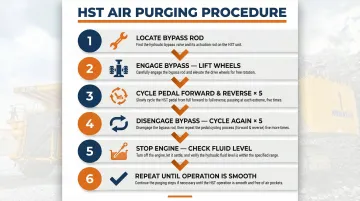
Perform the air purging procedure if air is suspected:
- Locate the transmission bypass rod or lever (consult your operator's manual for the specific location)
- With the bypass engaged and drive wheels off the ground, run the engine at low RPM
- Slowly cycle the drive pedal forward and reverse 5-6 times
- Disengage the bypass and cycle the pedal forward and reverse 5-6 more times
- Stop the engine, check fluid level, and add fluid as needed
- Repeat until movement becomes smooth and consistent
Inspect and replace leaking components:
- Replace any leaking seals, cracked hoses, or loose fittings identified in Step 1
- Even a pinhole leak will cause cavitation and ongoing fluid loss
Step 3: Fix Mechanical Issues If Fluid and Air Checks Don't Resolve It
Check charge pump pressure:
- If the system still underperforms after fluid, filter, and air correction, the problem is internal
- Use a hydraulic test gauge to check charge pump pressure against manufacturer specification
- Hydro-Gear BDU-10/21 units should maintain 25-70 PSI at 3000 RPM pump speed
- Low charge pressure confirms pump wear
Inspect the bypass valve or neutral adjustment:
- On many John Deere and Hydro-Gear units, an out-of-adjustment neutral can cause the machine to creep or fail to hold position
- Consult the service manual for the correct neutral adjustment procedure for your specific model
- Hydro-Gear ZT-2100/2200 units require loosening the return-to-neutral adjustment screw, rotating the control arm in 5-degree increments, and retorquing to 175-200 lb-in
Recognize when professional rebuild is necessary:
- Internal wear—pistons, barrel bores, valve plates, or bearings—requires full disassembly, specialized tooling, and precision measurement
- At this stage, a professional rebuild or exchange unit is the faster, lower-risk path to getting equipment back in service
Step 4: Test and Validate the Fix
Run a full operational test:
- Start at low RPM, gradually increase speed
- Test both forward and reverse under no load and under working load (driving on a slope or engaging the deck/implement)
Monitor fluid temperature during the test:
- Overheating that continues after fluid and filter service indicates remaining internal restrictions or component wear
Confirm smooth operation:
- Drive should engage smoothly, hold speed consistently under load, and produce no abnormal noise before returning the equipment to service
When to Fix vs Replace Your Hydrostatic Transmission
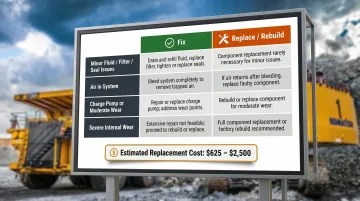
Three factors drive this decision: repair cost versus unit value, extent of internal damage, and how critical uptime is to your operation. The scenarios below map each common failure type to the right path.
Minor Fluid, Filter, or Seal Issues
Fix: Fluid changes, filter replacement, and seal or hose repairs are low-cost, DIY-viable fixes that typically restore full function. Always attempt these before escalating.
Replace: Only warranted if repeated seal failures point to an internal pressure or contamination source — meaning seals are a symptom, not the root problem.
Air in the System
Fix: System purging is a straightforward process that resolves most post-service or post-storage drive issues and costs nothing beyond time.
Replace: Not a replacement scenario. If purging fails, find and fix the underlying cause — typically a leaking seal introducing air.
Charge Pump Failure or Moderate Internal Wear
Fix: Replacing a charge pump or repairing valve plate damage is viable when the main pump and motor are in good condition and the unit hasn't run under contaminated fluid for a prolonged period. A qualified technician should handle this repair.
Replace/Rebuild: If charge pump failure has caused downstream damage to the variable pump or motor, a full professional rebuild is the more cost-effective path. Hydrostatic Transmission Service rebuilds units to manufacturer specifications, backed by a 1-year warranty, with a Short-Time exchange program that keeps your equipment running while your unit is being rebuilt.
Severe Internal Wear or Complete Drive Failure
Fix: Not recommended at the DIY level. Internal pump or motor repair without proper tooling and validation processes risks repeat failure — often at higher total cost.
Replace/Rebuild: For major internal failures, a professionally rebuilt or tested exchange unit is the most reliable and economical solution — particularly on equipment that's otherwise in good working order. Trade publications estimate transmission replacement costs between $625 and $2,500, making a professional rebuild the smarter call in most cases.
Preventive Maintenance to Avoid Future Problems
Fluid and Filter Service Schedule
- John Deere mandates an initial fluid and filter change at 50 hours for serviceable models (X500 Series, 2R Series compact tractors)
- Recurring intervals are every 200 hours
- Using the correct fluid type and keeping the system clean does more to extend HST life than any other maintenance step
Regular Visual Inspections
- Check all hoses, seals, fittings, and the transmission housing for early signs of leaks or heat discoloration
- Catching a failing seal early prevents contamination and low-fluid damage that leads to internal pump wear
Operational Habits That Accelerate HST Wear
How you run the equipment matters as much as how you maintain it. These habits put disproportionate stress on the transmission:
- Prolonged operation in high-load conditions with a cold transmission
- Bypassing the warm-up period in cold weather
- Overfilling the fluid reservoir (leaves no room for thermal expansion)
- Consistently working the equipment beyond its rated capacity
Frequently Asked Questions
What are common John Deere hydrostatic transmission problems?
The most frequently reported issues are loss of drive power, sluggish movement, fluid leaks, overheating, and whining noises. These often trace back to low or contaminated fluid, clogged filters, or worn internal pump components.
What causes a John Deere hydrostatic transmission to lose power or stop moving?
Four causes account for most failures: low hydraulic fluid, a clogged filter restricting flow, air trapped in the system, or internal pump/motor wear. Diagnose in this order to isolate the problem efficiently:
- Check fluid level first
- Inspect and replace the filter
- Purge air from the system
- Inspect internal pump/motor components last
What are the symptoms of a Hydro-Gear hydrostatic transmission problem?
Hydro-Gear HST issues typically present as jerky or inconsistent movement, reduced drive speed, inability to maintain speed under load, fluid leaks around the shaft seal, or unusual noise. The same fluid-first diagnostic sequence used for other HST brands applies here.
Can you adjust a John Deere hydrostatic transmission?
Yes, the neutral position and sometimes the transmission linkage can be adjusted on most John Deere models to correct creeping at idle or pedal misalignment. The specific adjustment procedure is detailed in the service manual for each model. If adjustment does not resolve the problem, internal wear is likely the cause.
How long does a John Deere hydrostatic transmission last?
With proper fluid and filter maintenance, a John Deere HST can last the life of the equipment — residential units average 500–1,500 hours; commercial units typically reach 1,000–3,500 hours. Premature failure almost always traces back to neglected fluid service, contamination, or overloading.
What is the best oil for a John Deere hydrostatic transmission?
John Deere specifies Hy-Gard (J20C, ISO 46-68) for standard applications or Low-Viscosity Hy-Gard (J20D, ISO 32) for cold weather operation. Using the wrong fluid type is a leading cause of seal degradation and pump damage, making manufacturer specification compliance essential.