Introduction
The forklift hydraulic pump drives every load-handling function on the machine. It sustains the system pressure that powers lifting cylinders, tilt valves, and mast controls — when it fails, the forklift stops working entirely.
Neglecting pump maintenance creates real operational and financial risk. Pressure loss, cavitation damage, and seal failures lead to emergency repairs, unexpected downtime, and safety hazards that could have been avoided. Unplanned downtime in material handling operations costs between $5,000 and $10,000 per hour, while hydraulic leaks account for roughly 20% of all forklift breakdowns.
Those numbers make a strong case for staying ahead of pump problems. This guide walks through maintenance approaches, warning signs, troubleshooting indicators you can monitor without specialized tools, and a practical service schedule tied to operating hours.
Key Takeaways
- The hydraulic pump powers all lifting and load control—when it fails, the forklift becomes inoperable
- Preventive maintenance costs $500–$1,500 annually per forklift versus $2,000–$4,000 for reactive pump repairs
- Watch for unusual noise, slow lift speeds, pressure loss, fluid leaks, and overheating
- Base service intervals on operating hours (typically every 500–1,000 hours), not calendar time
- Rebuild and exchange programs typically cost less and return equipment faster than sourcing a new pump
Why Forklift Hydraulic Pump Maintenance Is Important
A functioning hydraulic pump sustains the system pressure required to power every load-handling operation on your forklift. Even minor internal wear can trigger a chain reaction — degrading cylinders, valves, and hoses until the entire system goes down.
That risk has a direct dollar figure attached to it. Industry research shows that 70–80% of hydraulic system failures are caused by fluid contamination—a problem that's entirely preventable with routine filter changes and fluid analysis.
The Cost of Reactive vs. Preventive Maintenance
Consider these cost comparisons:
- Annual preventive maintenance program: $500–$1,500 per forklift
- Leaking hydraulic hose (reactive repair): $150–$300
- Hydraulic pump failure/rebuild: $2,000–$4,000
- Unplanned downtime: $5,000–$10,000 per hour
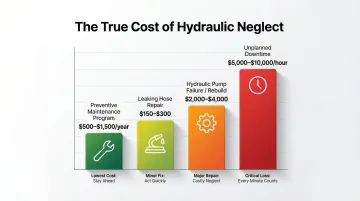
A $150 seal replacement identified during a routine inspection can prevent a $4,000 pump rebuild and days of lost productivity.
Safety and Compliance Risks
Poorly maintained hydraulic pumps create serious safety and compliance risks. OSHA accident investigations have documented fatalities from hydraulic fitting failures that caused sudden mast descent, as well as injuries from ruptured hoses that injected high-pressure fluid into operators' hands.
OSHA regulation 29 CFR 1910.178 explicitly requires:
- Immediate removal from service of any forklift found to be defective or unsafe
- Daily pre-shift examinations to identify conditions affecting safety
- Repairs performed only by authorized personnel
Skipping hydraulic pump maintenance exposes workers to serious injury and exposes operators to regulatory penalties — outcomes no maintenance schedule is worth risking.
Types of Maintenance for Forklift Hydraulic Pumps
Hydraulic pump maintenance isn't one-size-fits-all. The right approach depends on usage intensity, operating environment, and pump age.
Routine / Preventive Maintenance
Preventive maintenance includes scheduled tasks performed at regular intervals regardless of visible problems:
- Check fluid levels in the reservoir before each shift
- Inspect hoses and seals for weeping, cracking, or visible damage
- Replace filters at 250 hours initially, then every 1,000–2,000 hours per manufacturer specs
- Change hydraulic fluid every 2,000–2,500 hours under normal operating conditions
Major manufacturers recommend these intervals:
| Manufacturer | Hydraulic Fluid Change | Filter Replacement |
|---|---|---|
| Crown Equipment | 2,500 hours or 15 months | Per service schedule |
| Toyota | 2,000 hours | 2,000 hours |
| Hyster | 2,000 hours | Per service schedule |
| Caterpillar | 2,000 hours or 1 year | 500 hours or 6 months |
When performed consistently under normal conditions, preventive maintenance alone is sufficient. Annual costs typically run $500 to $1,500 per forklift, compared to thousands in reactive repair and lost production time.
Corrective / Reactive Maintenance
Reactive maintenance occurs after a problem becomes visible: leaks appear, pressure drops suddenly, or the forklift fails to lift. This approach leads to compounding damage — contaminated fluid destroys internal pump components while the underlying cause goes unaddressed.
A reactive hydraulic pump repair costs $2,000–$4,000 and typically requires 2–4 days of downtime, compared to a scheduled service visit that costs far less and can be planned around operational needs.
Predictive / Condition-Based Maintenance
Predictive maintenance uses fluid sampling, analysis, and pressure monitoring to spot early degradation before failure occurs. Technicians can detect metal particles in fluid or drops in flow rate that indicate wear, allowing intervention before catastrophic failure.
Implementing predictive maintenance strategies can reduce unplanned downtime by 30–50%. For high-utilization fleets operating multiple shifts or in demanding environments, this represents the ideal maintenance approach.
Key predictive indicators include:
- ISO 4406 particle counts (target 18/16/13 or cleaner)
- Water content monitoring (alarm limits typically 50–300 ppm)
- Viscosity testing (±10% variance triggers investigation)
- Elemental analysis for wear metals (iron, copper, aluminum, chromium)
Major / Overhaul Maintenance
A full overhaul becomes necessary when internal gear or piston wear exceeds tolerance, when repeated pressure failures occur despite fluid changes, or when pump age surpasses manufacturer service life.
Professional rebuild services, like those provided by Hydrostatic Transmission Service, can restore pumps to manufacturer specifications and reduce downtime compared to sourcing a new unit. Their Short-Time Exchange Program delivers quality-tested, warranted rebuilt units with a 1-year warranty, so equipment gets back online faster without the lead time of a new-unit order.
How to Check If Your Forklift Hydraulic Pump Needs Maintenance
Most pump problems announce themselves well before failure. The five warning signs below follow a logical diagnostic sequence — start with fluid and pressure, then check for noise, leaks, heat, and recurring patterns.
Reduced Lifting Speed or Pressure Loss
Sluggish mast movement, inability to hold a load at height, or a drop in maximum lift height all point to inadequate system pressure. Common causes include worn internal components, bypassing fluid, or low fluid levels.
Quick diagnostic:
- Check fluid level first
- Use a pressure gauge to compare system pressure against manufacturer specifications
- Compare readings to your OEM's specified range (typically 2,350–3,300 psi depending on capacity)
Unusual Noises: Cavitation and Aeration
Cavitation produces a steady, high-pitched whining sound caused by vapor bubble collapse when insufficient fluid reaches the pump inlet. Aeration creates an erratic whining noise augmented by a sound similar to marbles rattling inside the pump, caused by outside air entering the suction side.
Both indicate immediate problems requiring investigation:
- Low fluid levels in the reservoir
- Clogged inlet filter or breather cap
- Suction line leaks or bad shaft seals
- Incorrect fluid viscosity for operating temperature
Aeration often produces visible foaming in the reservoir, making it easier to identify than cavitation.
Visible Fluid Leaks or Contaminated Oil
Inspect for external pump leaks at shaft seals, mounting faces, and port connections during every pre-shift check. Milky, dark, or gritty fluid signals contamination or thermal breakdown — and contaminated fluid is one of the fastest ways to destroy pump internals. Check fluid color and smell every shift:
- Clean fluid: Amber, translucent, no odor
- Contaminated fluid: Milky (water), dark brown/black (oxidation), gritty texture (particles), burnt smell (overheating)
Overheating
A hydraulic pump running above manufacturer temperature thresholds indicates restricted flow, incorrect fluid viscosity, or system overload. Sustained overheating degrades seals and accelerates internal wear.
OEM temperature limits:
- Crown Equipment: 130°–200°F (54°–93°C) operating range
- Hyster: High temperature protection fault activates above 194°F (90°C)
If your hydraulic system consistently operates near or above these thresholds, investigate cooling capacity, fluid viscosity, and system load right away.
Recurring Pressure Drops or Unplanned Downtime
Repeated minor issues — pressure dips that self-correct, intermittent slow lifts, or temporary fixes that keep failing — are classic signs of progressive pump wear. If any of these patterns appear more than once, stop treating symptoms and schedule a full pump inspection or rebuild before the unit fails mid-shift.
Forklift Hydraulic Pump Maintenance Schedule
Maintenance schedules must be adapted to your operating environment. Forklifts running in dusty warehouses, outdoor yards, or multi-shift operations put significantly more stress on hydraulic components than light-use applications — and the service intervals should reflect that.
Standard Maintenance Intervals
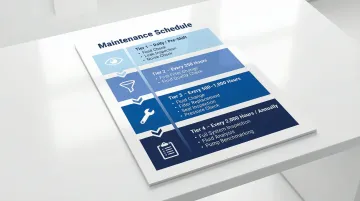
| Frequency | Maintenance Tasks |
|---|---|
| Daily / Pre-Shift | Check fluid level, visual inspection for leaks, listen for abnormal noises |
| Every 250 Hours | First filter change (break-in debris removal), full fluid quality check |
| Every 500–1,000 Hours | Hydraulic fluid change, filter replacement, seal and hose inspection, pressure system check |
| Every 2,000 Hours / Annually | Full system inspection, fluid analysis, pump performance benchmarking against manufacturer specs |
Adjusting for Severe Environments
Standard intervals assume clean, controlled environments. Under severe, dusty, or wet conditions, those intervals aren't enough — more frequent service is necessary to prevent premature pump failure.
High-usage scenarios requiring reduced intervals:
- Multi-shift operations (16+ hours daily)
- Outdoor environments with temperature extremes
- Dusty or contaminated work areas
- High-load applications exceeding 80% of rated capacity regularly
- Coastal or corrosive environments
For these conditions, consider halving standard intervals: change filters every 500 hours instead of 1,000, and perform full fluid changes annually rather than waiting for 2,000-hour marks.
Conclusion
Hydraulic pump maintenance is the single most effective way to prevent unplanned downtime, protect load-handling safety, and extend equipment life. The right maintenance strategy balances cost, reliability, and operational uptime.
Routine checks catch small problems before they become expensive failures. When rebuilds are needed, professional exchange programs offer a faster, cost-controlled path to getting back online compared to emergency repairs or new equipment purchases.
The numbers make the case: invest $500–$1,500 annually in preventive maintenance, or risk $5,000–$10,000 per hour in unplanned downtime plus $2,000–$4,000 in emergency pump repairs. For operations that can't afford extended outages, a rebuild or short-time exchange program through a specialist like Hydrostatic Transmission Service keeps equipment running with minimal disruption and a clear cost ceiling.
Frequently Asked Questions
How much does it cost to repair hydraulics on a forklift?
Costs vary by repair type. Minor seal or hose repairs typically run $150–$300, while full pump rebuilds range from $2,000–$4,000. Preventive maintenance programs ($500–$1,500 annually) significantly reduce total repair spend over time.
Can a hydraulic pump be repaired?
Yes, hydraulic pumps can often be rebuilt rather than replaced, especially when wear is caught early. Professional rebuilds restore pumps to manufacturer specifications, cost 50–70% less than full replacement, and typically include comparable warranties.
What is the common problem of a hydraulic pump?
Fluid contamination drives 70–80% of pump failures. Other frequent culprits include cavitation from low fluid supply, seal failure causing leaks, and pressure loss from internal wear. Routine fluid changes, filter replacements, and inspections prevent most of these issues.
How often should forklift hydraulic fluid be changed?
Most manufacturers recommend changing hydraulic fluid every 2,000 hours of operation or annually—whichever comes first. The initial filter change is typically due around 250 hours to remove break-in debris. Severe operating conditions may require more frequent changes at 1,000-hour intervals.
What causes cavitation in a forklift hydraulic pump?
Cavitation is caused by insufficient fluid reaching the pump inlet, resulting in vapor bubbles that collapse and damage internal components. Common causes include low fluid levels, clogged inlet filters, plugged breather caps, suction line leaks, or extreme oil temperatures that affect viscosity.
How do I know if my forklift hydraulic pump needs to be replaced?
Persistent pressure loss despite fluid and filter changes, excessive noise that doesn't resolve with maintenance, or metal debris in the fluid often indicate the pump is beyond repair. Contact a rebuild specialist to assess whether a pump rebuild or exchange unit is the more cost-effective path forward.