Introduction
When a hydraulic motor fails on a combine harvester, excavator, or industrial conveyor, the clock starts ticking on costly downtime. The immediate question becomes whether to repair what's failing or replace it entirely. In heavy equipment operations, every hour of downtime costs an average of $740 in lost productivity, overtime labor, and delivery delays—and choosing wrong compounds that cost.
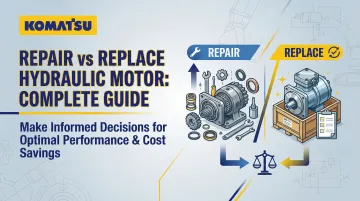
Repair can be faster and cheaper short-term, but replacement may be more cost-effective depending on the motor's condition, age, and repair history. The wrong call means repeat failures or unnecessary spending—neither of which a downed operation can afford.
This guide walks through the key factors that drive the repair-vs-replace decision: failure type, cost breakdowns, motor age thresholds, and when a remanufactured exchange unit is the smarter path. The global hydraulic motor market was valued at $14.40 billion in 2025, with remanufactured equipment alone representing a $257.3 billion global market—meaning you have more options than a binary fix-or-buy choice.
Key Takeaways
- Repair or rebuild when damage is isolated, the motor is relatively new, and costs stay well below replacement price
- Replace when the motor has catastrophic internal damage, is obsolete, or has recurring failures
- General rule: repair costs above 50% of a new motor's price usually make replacement the better call
- Key factors: damage extent, motor age, parts availability, downtime risk, and total cost of ownership
- Professional inspection is the most reliable way to make this call
Repair vs. Replace Hydraulic Motor: Quick Comparison
Cost
Repair/Rebuild: Generally lower upfront cost. Rebuilding typically costs 30% to 70% less than buying new, ideal when damage is limited to seals, bearings, or minor components.
Replace: Higher initial investment. Replacement may reduce total maintenance spend over time, particularly for older or frequently failing motors.
Downtime
Repair/Rebuild: Turnaround depends on parts availability and damage extent. Exchange programs—where a rebuilt unit is swapped in immediately—can cut downtime significantly. For example, Parker's custom delivery service can deliver tailored units within 2-3 days.
Replace: New units may be available faster if parts are in stock, but lead times for specialty motors can extend from 15 to 80 workdays depending on the product and region.
Lifespan After Service
Repair/Rebuild: A quality rebuild to manufacturer specifications can extend motor life considerably. Warranty-backed rebuilds add reliability assurance; Hydrostatic Transmission Service, for example, backs all rebuilds with a 1-year warranty.
Replace: New unit comes with full OEM lifespan and may include technology improvements over older models.
Parts Availability
Repair/Rebuild: Easier to source repair parts for current models. Older or discontinued motors may have rebuild parts that are difficult to source.
Replace: May be necessary when the motor is obsolete and rebuild parts are no longer manufactured.
Environmental Impact
Repair/Rebuild: Reduces raw material consumption by 80-98% and significantly saves energy compared to manufacturing a new unit, aligning with sustainability objectives.
Replace: Higher resource consumption to manufacture. Newer designs can offset this through long-term energy efficiency improvements.
When Repairing or Rebuilding a Hydraulic Motor Makes Sense
Understanding the distinction between "repair" and "rebuild" is important when evaluating options. A repair addresses a specific failure—replacing a seal or tightening a connection. A rebuild involves full disassembly, inspection of all internal components, replacement of worn parts, and performance testing to manufacturer specifications.
Common Issues That Are Typically Repairable
Certain failure types are well-suited to repair when caught early:
- External leaks from seal failure — resolved by replacing seals or tightening connections
- Fluid contamination — cleared through a system flush and filter replacement (though contamination causes 65% to 90% of all hydraulic-system failures, so prevention matters more than the fix)
- Valve sticking — cleaned and adjusted without internal disassembly
- Pressure imbalances — corrected by recalibrating system settings
Cavitation and overheating are conditional: both can be repaired if caught early, but if left unresolved they cause internal damage—pitted surfaces, fluid degradation—that may push the motor past the point of cost-effective repair.
Motor age and parts availability are key enablers of repair. A motor within a reasonable service life with available OEM or equivalent parts is a strong candidate for a rebuild rather than outright replacement.
The Operational and Financial Case for Professional Rebuilds
A certified rebuild restores the motor to manufacturer performance specs, includes a warranty, and typically costs a fraction of a new unit—making it the right call for operations watching maintenance costs. Rebuilding generally makes sense if the cost does not exceed 60% to 70% of a new component.
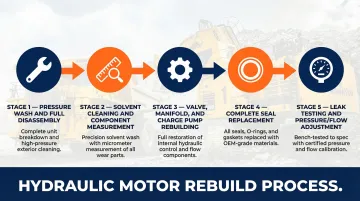
Hydrostatic Transmission Service offers rebuild-to-spec programs with a 1-year warranty and a Short-Time Exchange option, so customers receive a tested, warranted unit quickly and keep downtime to a minimum. Their rebuild process covers:
- Pressure washing and full disassembly
- Solvent cleaning and measurement of all working parts
- Valve, manifold, and charge pump rebuilding
- Complete seal replacement
- Leak testing and pressure/flow adjustment against manufacturer specifications
The cost savings extend beyond the invoice. Remanufacturing can reduce Global Warming Potential by over 50%, a meaningful advantage for operations with environmental or ESG targets.
When Replacing a Hydraulic Motor Is the Better Choice
Replace your hydraulic motor when the damage is too extensive for repair to make financial sense. That threshold typically involves catastrophic failure of internal components: the shaft, housing, or cylinder block damaged by prolonged overheating, severe cavitation, or untreated contamination.
Signs Your Hydraulic Motor Likely Needs Replacement
Clear replacement indicators include:
- Repeated failure of the same components after recent repairs (sign of systemic wear)
- Motor age beyond its designed service life with progressive performance decline
- Inability to source rebuild parts for discontinued or obsolete models
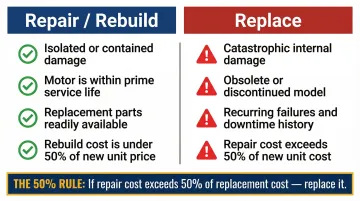
- Repair costs approaching or exceeding 50% of the cost of a new unit
The 50% Rule
The construction industry follows a 50/50 rule as a practical financial benchmark: when a repair estimate reaches roughly half the price of a new replacement motor, the cumulative costs of future repairs—combined with warranty limitations on the repaired unit—often make replacement the more cost-effective long-term decision.
Beyond cost, certain damage patterns also point toward replacement. Pressure imbalances and misalignment caused by internal component damage (not just system settings) suggest multiple parts are compromised simultaneously, making a full replacement more reliable than a piecemeal repair.
Replacement also makes sense when a new unit delivers clear operational gains:
- Improved energy efficiency that lowers running costs
- Better sealing technology that reduces future leak risk
- Compatibility with upgraded system components already in place
Repair vs. Replace: How to Make the Right Call
The decision should follow a structured evaluation, not a reactive response to failure. Start with a professional inspection to diagnose whether damage is isolated to replaceable components or has spread to core structural elements of the motor.
Key Questions to Work Through
- How old is the motor and what is its service history?
- How many components need attention?
- How critical is the equipment to daily operations, and how much downtime can the business absorb?
- Has this motor required repeated repairs in a short timeframe?
Cost Analysis Framework
Run the numbers on three inputs: full repair cost (parts + labor + service downtime), replacement unit cost, and expected remaining service life under each scenario. That comparison usually surfaces which option delivers better value per operating hour.
Downtime is a major variable in that math. Unplanned outages cost industrial manufacturers an average of $260,000 per hour, which means a faster turnaround path often justifies a higher upfront cost.

Situational Guidance
Choose repair or rebuild when:
- The motor is in its prime service life
- Damage is isolated
- A certified rebuild with warranty is available
When none of those conditions apply, replacement is usually the right move.
Choose replacement when:
- The motor is obsolete
- There's a pattern of recurring failures
- The rebuild cost crosses the 50% threshold
A Short-Time Exchange program threads the needle between these options: Hydrostatic Transmission Service ships a pre-rebuilt, tested unit immediately, and the original core is returned for credit. You get replacement-level reliability at rebuild-level cost, with minimal time off the floor.
Conclusion
Repairing or rebuilding is the right choice when damage is diagnosable, parts are available, and costs fall well below replacement value. That holds true especially when a certified service provider rebuilds to manufacturer specifications. Replacement makes more sense when the motor is obsolete, has sustained systemic damage, or when the long-term economics favor starting fresh.
The right decision reduces total maintenance costs, keeps equipment running at full capacity, and minimizes unplanned downtime—all of which directly affect productivity and profitability. If you're unsure which path fits your situation, a diagnostic evaluation from an experienced rebuild specialist can clarify the economics before you commit. Hydrostatic Transmission Service offers just that—with over 100 years of combined experience rebuilding and testing hydraulic motors to manufacturer specs, and a short-time exchange program designed to keep your downtime as short as possible.
Frequently Asked Questions
Is it cheaper to rebuild a motor or replace it?
Rebuilding is generally cheaper upfront, often costing 30% to 70% less than a new unit. However, the cost advantage depends on the extent of damage. If repair costs approach or exceed 50% of replacement cost, a new or rebuilt-exchange unit may be the more economical long-term choice.
What are the signs that a hydraulic motor needs to be replaced rather than repaired?
Key replacement indicators include catastrophic internal damage, a pattern of recurring failures after recent repairs, parts no longer available for obsolete models, and repair estimates exceeding 50% of new unit cost.
How long does a rebuilt hydraulic motor last?
A quality rebuild performed to manufacturer specifications can restore the motor to near-original service life. Actual lifespan depends on operating conditions, maintenance practices, and the quality of parts and workmanship used in the rebuild.
What does a hydraulic motor rebuild involve?
A rebuild covers full disassembly, cleaning, and component inspection, followed by replacement of worn seals, bearings, and damaged parts. The unit is then reassembled and performance-tested against manufacturer specifications before returning to service.
How much does it cost to repair a hydraulic motor?
Repair costs vary widely based on motor type, damage extent, and labor rates. Minor repairs typically cost $300 to $800, moderate repairs range from $800 to $1,500, and extensive overhauls can exceed $2,000. Request a professional evaluation from a qualified hydraulic specialist to get accurate pricing for your specific unit.
Can a hydraulic motor be repaired without replacing the entire unit?
Yes, most common hydraulic motor issues—seal failure, minor contamination, valve sticking, and early-stage cavitation—can be resolved by replacing only the affected components, making a full unit replacement unnecessary in many cases.