Introduction
Unplanned downtime costs Fortune Global 500 companies approximately $1.4 trillion annually, equivalent to 11% of their yearly turnover. Across U.S. manufacturing alone, unplanned equipment failures generate roughly $50 billion per year in losses, with pump and hydraulic system failures accounting for a large portion of that figure.
For industries running continuous operations—construction, agriculture, manufacturing, and material handling—a single pump failure rarely stays contained. It cascades into halted production lines, fluid system backups, and damaged downstream equipment. Per-hour revenue losses can reach $260,000 in general manufacturing and $2.3 million in automotive production.
The true cost of pump downtime is rarely the repair invoice itself. It comes down to three factors:
- Response speed — how fast your team identifies and engages the right repair resource
- Pre-failure preparation — whether spares, service contacts, and protocols are already in place
- Repair execution — how efficiently the process moves from diagnosis through return to service
Getting each of these right is what separates a 2-hour disruption from a 2-day shutdown.
Key Takeaways
- Pump failures trigger layered costs—lost production, emergency labor premiums, parts delays, and secondary equipment damage
- Most downtime traces back to slow response, unclear vendor relationships, and repairs that fail again within weeks
- Downtime shrinks when you act before failure: exchange programs, pre-qualified partners, and stocked critical parts all cut recovery time
- Predictive monitoring, scheduled inspections, and operator awareness reduce both how often and how badly pumps fail
How Downtime Costs from Pump Failures Accumulate
Pump downtime costs are not a single line item. They accumulate across multiple simultaneous cost streams that compound rapidly once a failure occurs.
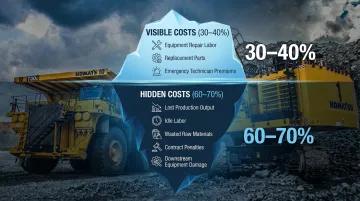
Visible costs account for just 30-40% of total downtime impact and include:
- Equipment repair labor and service calls
- Replacement components and parts
- Emergency technician premiums
Hidden costs make up the remaining 60-70% and hit harder than most operators expect:
- Lost production output during the outage
- Idle labor costs while equipment sits offline
- Wasted raw materials in interrupted processes
- Contract penalties for missed delivery deadlines
- Damage to connected equipment caused by fluid backup or pressure loss
How much any single failure costs comes down to decisions made long before the breakdown — how often maintenance runs, whether a replacement unit is on hand, and how quickly a qualified repair provider can respond. A seal that degrades over months may fail during peak demand, and without a ready solution, one component failure cascades into a full-shift loss.
Emergency calls during weekends or after-hours carry premium labor rates that can triple standard repair costs, turning a $100-per-hour technician into a $300-per-hour emergency specialist.
Key Drivers of Pump Downtime and Repair Costs
Response Time Gap
The interval between failure detection and the start of qualified repair work is typically the single largest driver of downtime duration. Every hour spent locating a service provider, waiting for technician availability, or sourcing components compounds production loss. Manufacturing benchmarks show that Mean Time to Repair (MTTR) averages 4-6 hours for well-prepared facilities, but poorly prepared operations can experience delays extending into days or weeks when critical parts or qualified technicians aren't immediately available.
Repair Quality Risk
A rushed repair that doesn't restore the pump to manufacturer specifications will result in re-failure within weeks — effectively doubling or tripling the original downtime cost. Quick-fix work creates a pattern of recurring emergencies rather than resolving the underlying problem.
Contamination-related failures account for 70-90% of all hydraulic system wear and often go unaddressed in hasty repairs, leading to cascading damage across the entire fluid system. What begins as a $500 pump replacement can escalate into a $5,000 system overhaul when contamination spreads unchecked.
Parts and Component Availability
Facilities with no critical spares on hand—and no relationship with a provider who stocks them—face lead times that can stretch a one-day repair into a multi-week outage. Standard lead times for industrial pumps range from several weeks to months; high-pressure piston pumps specifically can require 15 to 70 workdays depending on stock availability.
This gap between failure and parts arrival is often the longest segment of total downtime — and it's almost entirely preventable with the right supplier relationship in place before a failure occurs.
Pump Type and System Complexity
Hydrostatic and hydraulic pump systems require precision rebuild processes that take longer than simple component swaps. High-pressure axial piston pumps demand:
- Rigorous pressure testing and flow validation
- Calibration to manufacturer specifications
- Technicians trained on the specific pump family
Generalist repair shops often lack this capability. A specialist with direct experience on these systems returns a properly rebuilt unit — not one that fails again in 30 days.
Maintenance Posture
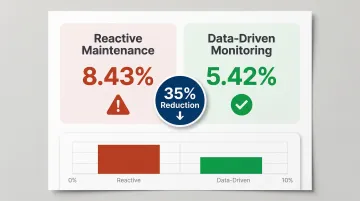
Reactive maintenance consistently produces worse outcomes across every metric: higher failure frequency, more severe damage at point of failure, and higher average repair costs. The data is clear: reactive maintenance averages 8.43% unplanned downtime annually, while data-driven monitoring brings that figure down to 5.42% — a 35% reduction. Scheduled inspection programs don't just prevent failures; they change the economics of repair entirely.
Cost-Reduction Strategies for Pump Downtime
Reducing pump downtime costs requires action on three fronts: decisions made before failure occurs, how pumps are managed day-to-day, and the operating conditions surrounding the system.
Strategies That Reduce Downtime by Changing Pre-Failure Decisions
Pre-qualify your repair provider before any failure occurs. Vendors with established response protocols and priority service agreements eliminate the time lost searching for qualified help mid-emergency. This relationship should include clear communication channels, documented response times, and confirmed availability of technicians familiar with your specific pump models.
Exchange programs dramatically compress recovery time. When a pump fails, a quality-tested rebuilt unit ships immediately while the original is serviced — reducing total downtime from days to hours. Hydrostatic Transmission Service's Short-Time Exchange Program, for example, delivers near-new performance for 30-50% less than new equipment costs while maintaining full warranty coverage.
Define rebuild quality standards upfront. A unit that fails again within weeks generates more total downtime than the original failure. Look for providers who test to original manufacturer specifications using Statistical Process Control Systems, documenting pressure and flow performance before shipment — and who back their work with warranty coverage.
Resolve your critical spare parts strategy in advance. Either maintain on-site stock of highest-risk components — seals, bearings, specific wear parts — or confirm your repair provider stocks them for your exact pump models with same-day availability. This decision alone can reduce parts-related delays from weeks to hours.
Strategies That Reduce Downtime Through Active Pump Management
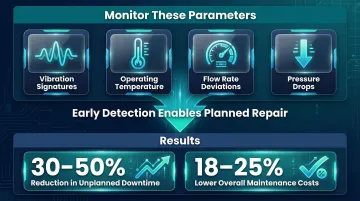
Predictive maintenance monitoring on high-criticality systems pays consistent dividends. Track the parameters most relevant to pump health:
- Vibration signatures reveal mechanical looseness or bearing wear
- Operating temperature trends expose loss paths and poor lubrication
- Flow rate deviations indicate internal leakage or seal degradation
- Pressure drops signal cavitation or impeller erosion
Predictive maintenance systems reduce unplanned downtime by 30-50% and cut overall maintenance costs by 18-25%. Early detection enables planned repair rather than emergency response.
Moving from reactive to scheduled maintenance means defining inspection intervals based on operating load and environment — not waiting for visible symptoms. OEM-recommended service intervals provide a practical baseline:
- Seal inspections and fluid analysis: per operating load conditions
- Oil changes: 4,000 hours for mineral oil, 8,000 hours for synthetic oil
- Piston pump service: approximately 10,000 hours
Failure history documentation is one of the most underused tools in maintenance planning. Log repair dates, failure modes, parts replaced, and operating conditions at time of failure. Facilities with this record can identify recurring patterns, rank pumps by risk, and schedule repairs before failure — rather than reacting after.
Operators and maintenance personnel need clear guidance on early warning indicators to watch for:
- Unusual noise or vibration changes
- Pressure loss or flow reduction
- Visible seal weeping or fluid leaks
- Temperature increases during normal operation
Catching these symptoms early can convert a potential multi-day emergency into a scheduled one-hour maintenance window.
Strategies That Reduce Downtime by Addressing the Operational Context
Pump redundancy is worth evaluating for any system where failure stops production entirely. A backup unit that comes online immediately converts a multi-day outage into a brief switchover. In mission-critical applications — infrastructure controls, continuous process lines — redundant pump/motor groups eliminate single-point failure risk. With average industrial downtime costing $260,000 per hour, redundancy capital often pays for itself after a single avoided outage.
System conditions that accelerate wear are often controllable. Auditing them systematically extends service life and reduces emergency failure frequency:
| Pump Type | ISO 4406 Cleanliness Target | Contamination Sensitivity |
|---|---|---|
| Gear Pumps | 19/17/14 | Important |
| Vane Pumps | 18/16/14 | Critical |
| Axial Piston Pumps | 18/16/13 | Critical |
| Servo Valve Systems | 16/14/11 | Super Critical |
Contamination causes 70-90% of all hydraulic system failures. Other controllable factors include:
- Operating pressure relative to rated capacity
- Temperature cycling and thermal stress
- Cavitation conditions from air entrainment
- Fluid viscosity inappropriate for operating temperature
A repair provider with deep knowledge of your specific pump models, operating history, and facility configuration will diagnose faster, source parts more accurately, and deliver better outcomes than one encountering the system for the first time during a crisis. Hydrostatic Transmission Service, for example, covers major brands including Sauer Danfoss, Eaton, Parker, Rexroth, and John Deere — with over 100 years of combined team experience and one-year warranties on all rebuilds.
Conclusion
Pump downtime costs accumulate through slow response, poor repair quality, and lack of preparation — not the repair bill itself. Pinpointing which factor is driving losses in your specific operation is the first step toward addressing them deliberately.
Facilities that establish exchange program relationships before failures occur, implement condition-based monitoring, and maintain documented failure histories consistently produce shorter outages and lower total costs than those relying solely on reactive emergency response.
The most practical next step is simple: identify your highest-risk components, establish a repair or exchange relationship before those components fail, and start logging failure data now. The preparation you do today determines how fast you recover tomorrow.
Frequently Asked Questions
What is the average cost of on-site pump repair?
On-site pump repair costs vary depending on pump type, failure severity, labor rates, and parts required. Rebuilds typically cost 40-60% of a new pump, but emergency premiums and system-wide contamination can push total costs 300-500% higher due to full system flushing and component replacement.
What is predictive maintenance for pumps?
Predictive maintenance tracks parameters like vibration, temperature, case-drain flow, and pressure to detect degradation before failure occurs. Because issues are caught early, repairs can be scheduled during planned windows rather than handled as emergencies—reducing unplanned downtime by 30-50%.
What is preventive maintenance for pumps?
Preventive maintenance involves scheduled, time-based servicing tasks—seal inspection, lubrication, bearing checks, fluid analysis—performed at fixed intervals regardless of observed symptoms. Unlike predictive maintenance, which responds to measured conditions, preventive maintenance follows manufacturer-recommended service intervals to prevent failure before it can occur.
What causes most emergency pump failures?
The most common causes of unexpected pump failures are seal degradation, bearing wear, cavitation damage, impeller erosion, and contamination. Contamination accounts for 70-90% of hydraulic component failures. Most of these conditions develop gradually and are detectable before catastrophic failure if monitoring and inspection practices are in place.
How long does emergency pump repair typically take?
Repair timelines range from hours to several days depending on failure type, parts availability, and repair method. Standard repairs average 5-10 business days, while expedited services can achieve 24-48 hour turnarounds.
What is a pump exchange program and how does it reduce downtime?
A pump exchange program allows a facility to receive a fully rebuilt and tested replacement unit immediately upon failure while their original pump is repaired separately. This eliminates the waiting time of repair and gets operations back online in hours rather than days, converting multi-day outages into brief equipment swaps with minimal production disruption.