
Introduction
When a skid steer hydrostatic drive fails, the machine stops moving entirely. Unlike mechanical gearboxes, hydrostatic drives rely on a closed-loop hydraulic circuit where a variable-displacement pump and motor work together to control wheel or track speed and direction.
That precision makes the system efficient—but also vulnerable to wear, contamination, and pressure imbalances.
Hydrostatic drive problems are among the most common and costly skid steer issues. Research shows that contamination in hydraulic systems causes 70% of failures, with internal wear, fluid contamination, charge pressure loss, and neglected maintenance driving most breakdowns. A single clogged filter or low fluid level can trigger cascading damage that destroys both pump and motor.
This guide covers the most common hydrostatic drive symptoms, how to systematically diagnose the root cause, how to apply the right fix, and when professional rebuild or exchange is the smarter call.
Key Takeaways
- Most skid steer hydrostatic drive problems trace back to four causes: internal pump/motor wear, low or contaminated hydraulic fluid, charge pressure failure, or control system issues
- Key symptoms: loss of drive power, machine pulling to one side, sluggish or no movement in one direction, unusual noises, and system overheating
- Fluid checks, filter swaps, and pressure tests resolve many issues; internal wear typically requires a professional rebuild or exchange unit
- DIY repairs on worn pistons, internal bypassing, or severe contamination—without proper tools and specs—risk compounding the damage
What Is a Skid Steer Hydrostatic Drive?
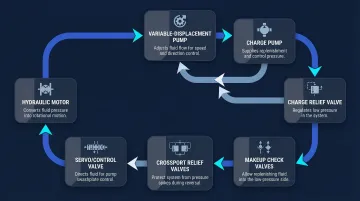
A skid steer hydrostatic drive is a closed-loop system that uses a variable-displacement pump and hydraulic motor to control wheel or track speed and direction—replacing the need for a mechanical gearbox. In a closed-loop circuit, fluid from the motor outlet flows directly back to the pump inlet without returning to the reservoir, creating a continuous hydraulic loop that responds instantly to operator input.
Key components work together to drive movement:
- Variable-displacement pump: Generates and regulates hydraulic fluid flow by adjusting swashplate angle — controlling both speed and direction
- Charge pump: Supplies makeup fluid to the closed loop to make up for internal leakage and maintain positive pressure
- Charge relief valve: Regulates charge pressure and provides a flow path for excess pump volume
- Makeup check valves: Direct makeup fluid from the charge pump into the low-pressure side of the closed loop
- Crossport relief valves: Limit maximum system pressure and absorb shock spikes
- Servo/control valve: Ports oil from the charge pump to spring-loaded cylinders for stroking the pump swashplate
- Hydraulic motor: Converts hydraulic pressure and flow into mechanical torque to drive wheels or tracks
This is a high-precision system. Modern hydraulic components are manufactured to extremely tight tolerances, with piston bore clearances of 5-40 microns and valve plate clearances of 1.5-10 microns.
Those microscopic gaps are what make the system so efficient — and so sensitive. Even small amounts of contamination or wear can cause rapid performance loss, which is exactly why understanding the symptoms of drive problems matters before they escalate.
Common Skid Steer Hydrostatic Drive Problems and Root Causes
Most hydrostatic drive failures follow predictable patterns that reveal themselves through specific symptoms. Knowing which symptom points to which root cause saves you diagnostic time and prevents unnecessary part replacements.
Problem 1: Loss of Drive Power or Complete Drive Failure
Symptoms: Machine moves slowly or not at all in one or both directions; reduced ability to climb grades or carry rated loads; drive feels "soft" under load.
Likely cause: Internal bypassing in the pump or motor due to worn pistons and barrel. When pistons and barrels wear, tight tolerances break down and high-pressure oil leaks into the pump case rather than driving the motor. This internal leakage increases as the system heats up and oil thins, causing bypass leaks to worsen rapidly.
Additional causes include:
- Loss of charge pressure preventing adequate makeup fluid in the closed loop
- Crossport relief valves opening prematurely, dumping pressure from the high side to the low side
- Charge pump failure starving the system of replenishing fluid
Problem 2: Skid Steer Drifts or Pulls to One Side
Symptoms: Machine veers left or right without operator input; uneven drive response between left and right sides.
Likely cause: One hydrostatic motor is producing less pressure or flow than its counterpart. Common culprits on the weaker side include:
- Internal wear reducing volumetric efficiency
- A failed shaft or piston seal
- A crossport relief valve stuck open, bleeding off pressure
The resulting pressure imbalance causes one drive side to generate less torque, pulling the machine toward the stronger side.
Problem 3: Overheating Hydraulic System
Symptoms: Hydraulic fluid temperature gauge spikes; burning smell; performance degrades during extended use or in hot conditions.
Likely cause: One of the disadvantages of hydrostatic drives is that the majority of the oil stays in the loop and doesn't return to the reservoir for cooling. Overheating typically results from:
- Blocked or bypassing inline filters reducing flow efficiency
- Hot oil shuttle valve malfunction preventing proper oil cooling return
- Excessive internal bypass generating heat from friction
- Low fluid level reducing cooling capacity
Problem 4: Sluggish or No Response in One Direction
Symptoms: Machine drives normally forward but not in reverse, or vice versa; delayed or uneven response when the joystick or pedal is moved.
Likely cause: If the drive only operates in one direction, check the crossport relief valves, the command voltage, the control valve and linkage, and the makeup check valves. Specific issues include:
- Control valve or mechanical linkage not fully stroking the pump swashplate
- Makeup check valves stuck or failing to open on one side
- Servo valve not shifting to the correct position due to a dirty pilot filter or faulty electrical signal to the amplifier
Problem 5: Abnormal Noises or Vibration During Operation
Symptoms: Grinding, whining, or knocking sounds from the drive system; vibration felt through the frame during movement.
Likely cause: Pump cavitation from a clogged charge pump suction filter or low fluid level. Cavitation occurs when high inlet vacuum causes vapor bubbles to form and implode, pitting valve plates and cylinder barrels. Worn motor bearings and contaminated fluid can produce similar symptoms.
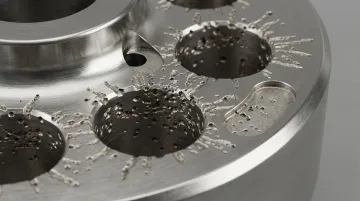
Critical warning: Metal particles from a failing pump can travel directly to the motor if inline filters are missing or clogged past their bypass threshold, causing cascading damage throughout the system.
How to Troubleshoot and Fix Skid Steer Hydrostatic Drive Problems
Attempting repairs without a structured diagnostic process leads to unnecessary part replacement, repeat failures, and potentially making the problem worse—especially in a closed-loop system where contamination from one failed component can destroy another.
Step 1: Check the Basics Before Touching the Drive System
Verify hydraulic fluid level and condition:
- Look for milky fluid indicating water contamination
- Check for dark discolored fluid indicating overheating degradation
- Confirm fluid is at the correct level per manufacturer specification
- Low fluid level is one of the most common causes of cavitation
Inspect the charge pump suction filter and inline filters:
- A contaminated suction filter is one of the most common causes of cavitation and sluggish performance
- Clogged filters can cause cavitation, which damages the charge pump
- Check for bypassing—if elements are partially plugged on non-bypassing filters, the drive will slow down
- Replace filters at manufacturer intervals (typically every 500 hours for most brands)
Confirm mechanical linkage or joystick wiring is fully connected:
- If the machine won't move in one direction, rule out a disconnected cable or wiring fault to the servo valve before assuming internal failure
- Check for binding in mechanical linkages that prevent full swashplate stroke
Step 2: Measure Charge Pump Pressure
Charge pressure is the primary diagnostic indicator in any hydrostatic system—low readings point to a failing charge pump, clogged suction filter, or failed charge pump relief valve.
How to test:
- Attach a pressure gauge to the appropriate test port (consult service manual for location)
- Check pressure at idle in neutral—typical range is 200-300 PSI
- Check pressure under load while stroking the pump
- Note when readings deviate from the expected range
What the readings mean:
- Normal idle pressure (200-300 PSI): Charge pump and relief valve functioning correctly
- Pressure drops slightly under load: Normal flow demand
- Pressure drops to 0 PSI under load: Severe internal leakage or failed makeup check valve
- Erratic or fluctuating readings: Cavitation from low oil, collapsed hose, or dirty filter
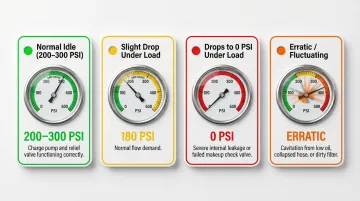
This single reading narrows the diagnosis considerably—use it to decide whether to continue into component-level testing.
Step 3: Diagnose by Component—Pump, Motor, or Control
When charge pressure checks out but performance is still poor, the fault lies in the pump, motor, or control valve. Work through each sub-system in order.
If charge pressure is normal but drive performance is poor:
Check for excessive case drain flow at the main pump and motor. The condition of a pump or motor can be determined by measuring the flow from its case-drain line and expressing it as a percentage of its theoretical flow. Higher-than-normal case drain flow indicates internal bypass wear—visibly elevated flow compared to baseline readings confirms worn internal components.
Check the crossport relief valves:
- If one valve is stuck open, pressure on the high side of the loop bleeds off, causing loss of power or one-directional failure
- Test by swapping valves side-to-side to confirm which is faulty
- If symptoms switch sides, the valve is the problem
Inspect the servo or proportional valve:
- If pump output is zero GPM when a signal is applied, check the command voltage and current to the amplifier
- Inspect the servo valve's small pilot filter for clogging—a blocked pilot filter will prevent the pump from stroking
- The oil flow to the servo valve is filtered by a non-bypassing 3- to 10-micron element
Step 4: Apply the Correct Fix Based on Root Cause
For fluid, filter, and minor seal issues:
- Drain and refill with the correct fluid specification
- Replace clogged filters (suction, inline, and pilot filters)
- Re-test charge pressure after service
- These are the fixes an operator can perform on-site with the right supplies
For control/linkage issues:
- Adjust or replace the mechanical cable linkage
- Reconnect or test wiring to the servo valve
- Null the valve if the machine drifts in neutral
- Replace the joystick circuit board if wiring checks out
When the pump or motor has worn internally: This requires full disassembly, inspection, and component replacement to manufacturer tolerances. When a hydrostatic pump fails, generated metal debris will migrate directly to the hydrostatic wheel motors if inline pressure filters are absent or in bypass mode.
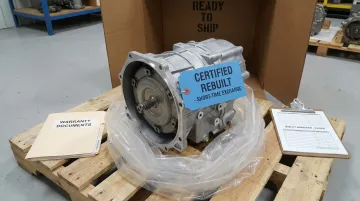
Critical: Flush all contaminated lines before installing any rebuilt component—skipping this step causes immediate re-failure. Hydrostatic Transmission Service performs system contamination control as part of every rebuild, which is why their units carry a 1-year warranty.
Step 5: Test and Validate the Fix
After any repair, run the machine progressively from light operation to full load:
- Monitor charge pressure—should remain stable in the 200-300 PSI range at idle
- Check case drain flow—should return to baseline levels
- Test drive response in both directions—should be smooth and equal
- Monitor system temperature—should stabilize within normal operating range
Document baseline readings (charge pressure, case drain, max operating pressure) after a successful repair to enable faster future diagnostics.
When to Fix vs. Replace Your Skid Steer Hydrostatic Drive
The fix vs. replace decision comes down to one core question: has the damage stayed external, or has it reached the pump and motor internals? Your answer determines whether a quick repair gets you running or whether a rebuild is the only path forward.
Fix When:
No internal contamination is present. If the problem traces back to a filter, fluid condition, or external seal/hose, you can restore performance without touching the pump or motor internals. Common repairs at this level include:
- Replacing clogged suction or inline filters
- Topping off or changing contaminated hydraulic fluid
- Replacing external seals or damaged hoses
- Adjusting charge relief valve pressure
The fault is in the controls, not the hydraulics. If the control linkage, wiring, or servo valve is the culprit and the pump and motor show no signs of bypass wear, a valve replacement or linkage adjustment costs a fraction of a full rebuild.
Replace or Rebuild When:
Internal bypass or metal contamination is confirmed. If case drain flow testing shows excessive bypassing in the pump or motor — or you find metal particles in the fluid — continued operation will accelerate damage and risk destroying both components together.
The failure was sudden and catastrophic. A seized pump or major pressure loss can't be reliably fixed in the field. Attempting it without clean-room conditions and precision measurement tools typically results in repeat failure within weeks. Modern hydraulic components are manufactured to extremely tight tolerances and require specialized equipment to rebuild correctly.
When a rebuild or exchange is the right call, Hydrostatic Transmission Service's Short-Time Exchange Program ships a tested, warranted unit quickly so your equipment doesn't sit idle. Your failed unit is then rebuilt under proper contamination controls — not patched in the field.
Preventive Maintenance and Common Mistakes to Avoid
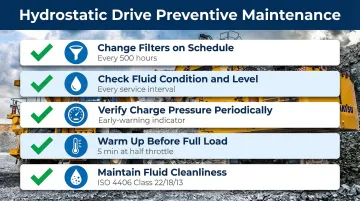
Key preventive actions that extend hydrostatic drive life:
- Change filters on schedule: Replace the charge pump suction filter and inline filters every 500 hours (or more frequently in dusty/dirty environments)
- Check fluid condition and level: Inspect hydraulic fluid at every service interval—look for discoloration, contamination, or low level
- Verify charge pressure periodically: Use charge pressure as an early-warning indicator of pump wear before symptoms appear
- Warm up before full load: Always allow the machine to warm up for at least five minutes at less than half throttle in cold conditions—keep temperatures 30°F (16°C) above the pour point of the hydraulic fluid
- Target proper fluid cleanliness: Maintain ISO 4406 Class 22/18/13 or better for optimal component life
Two Mistakes That Destroy Drives Quickly
Running with low fluid or a tripped filter indicator is the single most damaging habit. Even brief cavitation can score the pump barrel and pistons, starting bypass wear that compounds with every operating hour until the drive fails completely.
Skipping system flush after a pump replacement is equally destructive. Metal debris left in the lines, motor, and reservoir will contaminate a rebuilt or new pump within hours of startup. A single step down in ISO cleanliness class doubles the particle concentration in the oil, accelerating wear on every precision surface in the circuit.
Before reinstalling any pump, flush the entire system, inspect the reservoir for sludge, and replace all filters—not just the unit itself.
Conclusion
Most skid steer hydrostatic drive problems—from one-sided pulling and sluggish response to full drive failure—have identifiable root causes that can be diagnosed through charge pressure testing, case drain flow checks, and control system inspection. The key is understanding the difference between:
- Simple field fixes: clogged filters, low fluid, linkage adjustments
- Professional repairs: internal bypass wear, metal contamination, pump or motor component failure
Early intervention is the most cost-effective path. Catching a clogged filter or low charge pressure before it causes internal bypass wear is far less expensive than a full pump-and-motor rebuild. Knowing when internal wear has progressed beyond field repair is just as critical — DIY attempts on worn internal components without proper tools, clean conditions, and manufacturer specs typically cause repeat failure and additional damage.
When a rebuild or exchange unit becomes necessary, Hydrostatic Transmission Service rebuilds and tests components to manufacturer specifications — with a 1-year warranty and a short-time exchange program designed to get your equipment back in service fast. Contact the team at (800)-361-0068 or sales@htsrepair.com to discuss your repair options.
Frequently Asked Questions
Why won't the hydraulics work on my skid steer?
The most common causes are low hydraulic fluid level, a clogged filter reducing flow, or a charge pump issue preventing pressure from building in the system. Start by checking fluid level and filter condition—these are the fastest diagnostics that solve the majority of hydraulic problems.
What are the signs of hydrostatic failure?
Key indicators include gradual or sudden loss of drive power, the machine pulling to one side, overheating during normal operation, sluggish or no response in one direction, and abnormal grinding or whining noises from the drive system. Multiple symptoms appearing together typically indicate internal component wear.
How to tell if a final drive is bad?
Signs of a bad final drive include the machine veering to one side, one wheel or track not turning when it should, and noise or vibration localized to one side. Flow testing and pressure checks on that side's motor can confirm whether the final drive motor has excessive internal bypass.
Can hydraulic motors be repaired?
Yes—hydraulic motors can be rebuilt by replacing worn pistons, barrel, valve plate, and seals. Rebuilds must meet manufacturer tolerances with strict contamination controls, so professional rebuild services are strongly recommended over field repairs—which typically result in repeat failure without the right tools and clean environment.
How long do hydrostatic transmissions last?
Lifespan depends heavily on maintenance quality—specifically regular fluid and filter changes, avoiding cavitation, and using the correct fluid specification. A well-maintained skid steer typically lasts 4,000 to 6,000 hours on average, with some reaching 8,000 to 10,000 hours.