Introduction
The Rexroth Bosch A6VM is a variable displacement axial piston hydraulic motor used in travel drives, winches, and hydrostatic systems across construction, agricultural, and industrial equipment. Built for demanding duty cycles, it holds up well under load — until contaminated fluid, high operating hours, or deferred maintenance catch up with it.
When failures do occur, the window between early symptoms and a full rebuild is narrow. Timely diagnosis and repair prevent a worn seal from escalating into damaged cylinder bores or a failed drive shaft.
This guide covers everything a field technician or fleet manager needs to address A6VM problems before they compound:
- Common A6VM failure patterns and their root causes
- Step-by-step diagnostic and repair process
- Fix-versus-replace decision framework
- Preventive maintenance practices to extend service life
Getting the diagnosis right the first time saves time, money, and keeps equipment available when it's needed.
Key Takeaways
- Top A6VM failure modes: worn seals, port plate wear, torque/speed loss, bearing noise, cavitation, overheating, and displacement control faults
- Seal replacements, port plate resurfacing, and control adjustments are all repairable when caught early
- Always diagnose first—confirm whether the fault is mechanical, hydraulic, control-based, or operational before opening the unit
- Severe scoring or cascading failures make a professional rebuild or exchange unit faster and more cost-effective than field repair
What Is the Rexroth A6VM?
The A6VM is a variable displacement axial piston hydraulic motor from Rexroth Bosch, designed to convert hydraulic pressure and flow into rotational torque and speed. A servo-controlled swashplate adjusts the displacement angle continuously, giving operators precise control over both speed and torque output.
That adjustability makes the A6VM well-suited for demanding hydrostatic drive applications across mobile and industrial equipment. Key design characteristics include:
- Variable displacement range via swashplate angle adjustment
- High torque output at low speeds for heavy-load applications
- Servo-controlled response for dynamic speed modulation
- Compact axial piston design for power-dense installations
That same precision is also its vulnerability. The A6VM operates within tight internal tolerances — and those tolerances degrade with operating hours. Contamination and wear accelerate the process, eventually causing bearing failure, valve block scoring, and loss of displacement control. Periodic inspection isn't optional; it's what prevents a minor service interval from becoming a full rebuild.
Common A6VM Problems and Their Root Causes
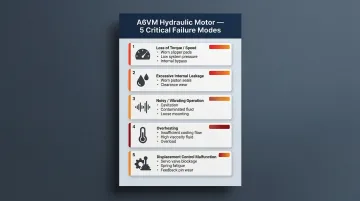
A6VM failures typically follow predictable patterns tied to fluid condition, mechanical wear, and control system degradation. The five problems below cover the most common failure modes — and knowing which one you're dealing with determines whether a field fix is viable or a full rebuild is needed.
Problem 1 — Loss of Torque or Output Speed
Symptoms:
- Sluggish acceleration
- Inability to reach rated speed under load
- Reduced pulling force
Root causes:
- Worn cylinder block bores
- Slipper pad wear on pistons
- Damaged port plate reducing volumetric efficiency
Problem 2 — Excessive Internal Leakage
Symptoms:
- High case drain flow (measure and compare against manufacturer spec)
- Motor running hot
- Output shaft lagging under load
Root causes:
- Worn or damaged port plate
- Piston/bore clearance beyond tolerance
- Degraded shaft seals
Problem 3 — Noisy or Vibrating Operation
Symptoms:
- Knocking, grinding, or high-pitched hydraulic noise during operation
Root causes:
- Bearing failure
- Cavitation from insufficient inlet pressure or blocked case drain
- Fluid contamination with abrasive particles reaching rotating components
Problem 4 — Overheating
Symptoms:
- Abnormally high case drain temperature
- Fluid discoloration
- Thermal shutdowns
Root causes:
- Restricted case drain line
- Inadequate fluid cooling
- Operating beyond rated continuous pressure
- Heavily contaminated fluid increasing internal friction
Problem 5 — Displacement Control Malfunction
Symptoms:
- Motor stuck at minimum or maximum displacement
- Erratic speed response
- Failure to respond to control input
Root causes:
- Sticking servo piston
- Blocked control orifice
- Damaged proportional control valve
- Incorrect control pressure
How to Fix the A6VM: Step-by-Step
Proceeding directly to disassembly without a structured diagnostic process is the most common and costly mistake in A6VM repair. It leads to unnecessary parts replacement and repeat failures.
Step 1: Identify the Exact Problem
Observe and record visible symptoms:
- Check for external leaks at shaft seal and port connections
- Listen for abnormal noise at startup versus under load
- Note any vibration pattern or overheating
Measure and document key operating parameters:
- Case drain flow rate
- Inlet/outlet pressure differential
- Shaft speed under rated load
- Control pressure
Compare these against A6VM datasheet values. Deviations pinpoint the failure zone.
Step 2: Confirm the Root Cause Category
Classify the fault before touching components:
- Mechanical (internal wear)
- Hydraulic/fluid (contamination, cavitation, low inlet pressure)
- Control-based (servo/proportional valve, control circuit)
- Operational/environmental (overloading, poor installation, inadequate drain line)
Rule out external system factors first:
- Verify system pump output
- Filter condition
- Fluid level and cleanliness
- Case drain back-pressure
This avoids misdiagnosing a system problem as a motor fault.
Step 3: Perform the Repair Based on Fault Type
The repair action is determined by the root cause category confirmed in Step 2. Each fault type below maps directly to the work required — follow only the path that matches your diagnosis.
Mechanical Fault: Internal Wear or Damage
Disassemble per Rexroth's A6VM service specification, then inspect:
- Cylinder block, pistons, slipper pads, retaining plate, and port plate for scoring, wear grooves, or dimensional deviation
- Port plate damage is a leading cause of volumetric loss — replacement is usually required rather than polishing
During reassembly:
- Replace all seals, O-rings, and shaft seal as a set
- Check bearing preload and condition — do not reuse bearings showing pitting, discoloration, or play
Hydraulic or Fluid Fault: Contamination or Cavitation
Flush the system and replace hydraulic fluid if contaminated. Cleanliness requirements:
- ISO 4406 20/18/15 minimum under normal conditions
- Tighten to 19/17/14 when fluid viscosity drops below 10 mm²/s
- Optimum operating viscosity: 16 to 36 mm²/s (cSt)
Also check:
- Case drain line for back-pressure restrictions — clear any blockages
- Inlet supply pressure — must meet the minimum specification to prevent cavitation
Control or Displacement Fault: Servo or Proportional Valve
Inspect and service the control system:
- Check the servo piston for sticking or seal damage
- Verify control orifice is clear and control pressure is within specification
- Recalibrate the proportional valve, or replace it if response is erratic
Before making any adjustments, document all current control settings. Incorrect displacement range changes can cause overspeed or stall conditions on reassembly.
Step 4: Test and Validate the Repair
Break-in and commissioning:
- Run the A6VM through a low-pressure break-in cycle before applying full system load
- Monitor for noise, vibration, temperature rise, and case drain flow during commissioning
Performance verification:
- Confirm output speed and torque match expected performance under rated load conditions
- Log results against pre-repair measurements to verify the fault is resolved
- Watch for recurrence over the first 50 operating hours
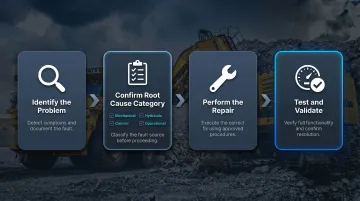
If performance falls short after commissioning, revisit Step 2 — a recurring fault usually means the root cause category was misclassified, not that the repair itself was faulty.
Fix vs. Replace: A6VM Decision Guide
The right call depends on repair cost, downtime exposure, and long-term reliability. Use the scenarios below to match your situation to a recommended path. A repaired motor carrying hidden wear may fail again — a fully rebuilt and tested unit removes that uncertainty.
Scenario 1 — Minor Seal or Port Plate Wear, Motor Otherwise Sound
- Fix. Replace the shaft seal, port plate, and piston seals
- Cost and downtime are minimal
- The motor returns to near-original efficiency
Scenario 2 — Cylinder Block or Piston Bore Scoring
- Evaluate carefully. Component replacement can correct light scoring
- Deep scoring means dimensional tolerances are compromised
- Full rebuild or exchange is more reliable than piecemeal field repair
Scenario 3 — Bearing Failure With Secondary Contamination Damage
- Replace or exchange. Bearing failure scatters metal debris throughout the motor, creating wear on multiple components at once
- A full strip and rebuild is required
- An exchange unit is often the faster path back to operation
Scenario 4 — Displacement Control Fault With Intact Mechanical Components
- Fix. Servo piston and control valve repairs are targeted and cost-effective
- Do not exchange the entire unit for an isolated control issue
When in-field repair isn't practical or downtime cost is high, Hydrostatic Transmission Service's Short-Time Exchange Program provides a fast alternative. Exchange units are rebuilt and tested to manufacturer specifications and carry a 1-year warranty.
Preventive Maintenance and Mistakes to Avoid
Most A6VM failures trace back to the same preventable mistakes. Catching them early — or avoiding them entirely — is far cheaper than a full rebuild.
Most Costly A6VM Repair Mistakes
Misdiagnosing the problem is the fastest route to a repeat failure. Watch for these patterns:
- Topping up fluid without addressing the contamination source
- Skipping functional testing after repair, leaving the root cause unconfirmed
- Using non-OEM seal kits or parts with incorrect material ratings that degrade faster under high-pressure cycles
Preventive Maintenance Schedule
Keep the motor running reliably with these scheduled checks:
Fluid cleanliness:
- Monitor hydraulic fluid and replace at manufacturer-recommended intervals
- Maintain ISO 4406 cleanliness of 20/18/15 minimum — tighten to 19/17/14 when operating above 73°C (HLP 32) or 85°C (HLP 46)
System inspections:
- Inspect and clear the case drain line regularly to prevent back-pressure buildup
- Check shaft seal for weeping at each scheduled service point
- Log operating hours to anticipate bearing and port plate service intervals
Installation and Operating Requirements
Get these right at startup — some errors are immediately destructive:
- Verify the case drain line is connected before startup; running without it destroys the motor immediately
- Avoid prolonged operation above rated continuous pressure
- Confirm system filtration meets Rexroth's specified cleanliness level — contamination is the most common cause of premature A6VM failure
Seal selection matters as much as installation. NBR seals are rated to +78°C continuous; FKM seals handle up to +103°C (measured at the drain port). For construction and agricultural applications where case drain temperatures routinely exceed 75°C, specify FKM seals from the outset.
Conclusion
The A6VM is a robust and repairable motor when issues are caught early. Most failures trace back to contaminated fluid, worn port plates or seals, or control system faults—all addressable with proper diagnosis.
Cost-effective repair comes down to three steps:
- Identify the root cause before disassembly
- Make the fix-versus-exchange decision based on failure severity and downtime cost
- Apply preventive maintenance to stop the same fault from recurring
For complex rebuilds or time-sensitive situations, Hydrostatic Transmission Service offers A6VM rebuild and short-time exchange programs. Contact the team at (800)-361-0068 or sales@htsrepair.com to discuss your unit.
Frequently Asked Questions
What are the most common causes of A6VM motor failure?
Contaminated hydraulic fluid and case drain restriction are the leading causes, followed by mechanical wear on the port plate, pistons, and bearings from high operating hours or cavitation. Maintaining ISO 4406 cleanliness of 20/18/15 minimum is critical.
How do I check if my A6VM has excessive internal leakage?
Case drain flow rate is the primary indicator. Measure actual drain flow and compare it against the Rexroth-specified maximum for the motor's displacement setting. Flow above spec confirms internal wear requiring port plate or seal service.
Can I repair an A6VM motor in the field, or do I need a specialist?
Seal replacements, case drain clearing, and control valve repairs can often be performed by trained technicians on-site. However, cylinder block and bearing damage require a controlled shop environment and precision measurement tools for reliable repair.
What hydraulic fluid specification does the A6VM require?
The A6VM requires HLP mineral oil per DIN 51524 with an optimum operating viscosity of 16 to 36 mm²/s. ISO 4406 cleanliness of 20/18/15 is mandatory, tightening to 19/17/14 when viscosity drops below 10 mm²/s. Using incorrect or dirty fluid is the fastest way to reduce motor life.
How long does a professional A6VM rebuild take?
Rebuild time varies by damage extent. Exchange programs — such as the Short-Time Exchange offered by Hydrostatic Transmission Service — ship a pre-rebuilt unit immediately, often restoring equipment to operation within days rather than waiting weeks for an in-shop rebuild.
What is the typical service life of an A6VM motor?
Service life depends heavily on fluid cleanliness, operating pressure, and maintenance frequency. With these factors controlled, the A6VM can deliver thousands of operating hours before requiring major service. Regular monitoring of case drain flow and bearing condition helps anticipate service intervals.