Introduction
Hydraulic pumps convert mechanical energy into the hydraulic force that powers excavators, material handlers, and manufacturing equipment across industrial, construction, and agricultural operations. When they fail, the consequences hit fast: fluid contamination, seal failure, cavitation damage, and unplanned downtime that routinely costs more than the repair itself.
According to a 2023 ABB survey of over 3,200 global plant maintenance leaders, two-thirds of industrial companies experience unplanned downtime at least once a month, carrying a median cost of $125,000 per hour.
For most facilities, proactive pump maintenance is what separates a planned repair from an emergency shutdown. This guide covers how to recognize when a hydraulic pump needs attention, the different maintenance approaches, warning signs of failure, and a practical service schedule to follow.
Key Takeaways
- Hydraulic pump maintenance drives equipment uptime and total operating cost
- Four maintenance types cover the full service spectrum: preventive, corrective, predictive, and overhaul, each with distinct cost profiles
- Most pump failures stem from contamination, cavitation, overheating, and seal wear—all largely preventable
- Reduced pressure, unusual noise, visible leaks, and rising temperatures signal immediate service needs
- Structured schedules spanning daily checks to annual overhauls keep pumps running to spec
Why Hydraulic Pump Maintenance Matters
Regular maintenance creates a direct link between service investment and long-term equipment value. A well-maintained hydraulic pump can operate reliably for many years, while a neglected one degrades rapidly—creating a cycle of reactive repairs that escalate quickly.
Internal wear, contaminated fluid, and degraded seals force the pump to work harder to maintain pressure, increasing energy consumption and reducing output consistency. The U.S. Department of Energy documents that structured preventive maintenance programs yield a 70% to 75% reduction in breakdowns and a 35% to 45% reduction in overall downtime.
Hydraulic systems operate under extreme pressure, and a failing pump can cause hose ruptures, fluid injection injuries, or sudden equipment shutdowns. Neglecting maintenance doesn't just cost money — it creates conditions where serious injury becomes a realistic outcome.
The stakes across all three dimensions are worth keeping in focus:
- Efficiency: Worn or contaminated components increase energy draw and reduce pressure consistency
- Reliability: Structured maintenance cuts breakdown frequency by up to 75%, per DOE data
- Safety: Pressure-related failures can cause immediate, severe harm to personnel and equipment
Types of Hydraulic Pump Maintenance
No single maintenance approach fits all situations—the right strategy depends on equipment usage intensity, operating environment, and acceptable risk of downtime.
Preventive (Routine) Maintenance
Preventive maintenance follows scheduled, time-based service performed regardless of visible symptoms. Tasks include checking fluid levels and quality, inspecting seals and fittings for early leaks, cleaning or replacing filters, and monitoring operating temperature.
When preventive maintenance is sufficient:
- Low- to moderate-use environments
- Equipment with predictable load cycles
- Situations where downtime scheduling is feasible
Per-incident costs stay predictable, and scheduling service around production windows avoids the disruption that reactive repairs create.
Corrective (Reactive) Maintenance
Corrective maintenance addresses faults after they appear—replacing failed seals, clearing clogged filters, or addressing pressure loss after it has already disrupted operations.
Over-relying on this approach costs more due to emergency labor, collateral component damage, and unplanned production halts. The U.S. Department of Energy's FEMP O&M Best Practices Guide documents that reactive maintenance costs 3 to 5 times more than planned preventive maintenance.
Predictive / Condition-Based Maintenance
Predictive maintenance uses real-time performance data—pressure readings, flow rate measurements, fluid analysis, and temperature monitoring—to trigger service only when specific thresholds are breached. This reduces unnecessary maintenance while catching emerging faults early.
Tools involved:
- Pressure gauges
- Flow meters
- Thermal imaging
- Oil particle counters
This approach suits high-value or high-criticality pumps where both over-maintenance and under-maintenance carry significant costs. Even with excellent monitoring in place, most pumps eventually reach a point where incremental repairs are no longer enough—which is where a full overhaul becomes necessary.
Major Overhaul Maintenance
A major overhaul involves full disassembly, inspection, and rebuild of the pump—replacing all seals and O-rings, inspecting pistons/gears/vanes for wear, polishing or replacing scored cylinders, and reassembling to manufacturer torque specifications.
When an overhaul is required:
- After a certain number of operating hours
- Following a major contamination event
- When corrective measures no longer hold
Technicians performing overhauls need access to manufacturer specifications and precision testing equipment to return the pump to proper tolerances. For operations where downtime is costly, a professional exchange program—such as the rebuild and exchange service offered by Hydrostatic Transmission Service—can replace a worn pump with a tested, warranted rebuilt unit faster than an in-house overhaul allows.
Warning Signs Your Hydraulic Pump Needs Service
Recognizing these indicators before a full failure occurs is what separates planned maintenance from emergency repairs.
Pressure and Flow Irregularities
A noticeable drop in system pressure or inconsistent flow rates is one of the clearest signs of internal wear. Worn pistons, gears, or vanes reduce volumetric efficiency, meaning the pump can no longer maintain required output.
How to diagnose:
- Use a pressure gauge to establish a baseline during normal operation
- Monitor for deviation from baseline readings
- Note if pressure builds slowly then drops under load
- Check for check valve issues or seal degradation if pressure drops occur without other mechanical symptoms
Catching these patterns early helps you target the right repair instead of replacing components that aren't actually failing.
Abnormal Noise and Vibration
Different sounds signal different problems:
- Grinding: Typically signals gear or bearing wear
- Whining or high-pitched noise: Often indicates cavitation (the pump is starving for fluid)
- Rattling: Can mean loose internal components or air ingestion
Excessive vibration not typical of normal operation suggests rotor imbalance or bearing failure. Vibration accelerates wear on surrounding components and fittings, so it should trigger immediate inspection rather than monitoring.
Fluid Leaks and Contamination
External leaks around shaft seals, fittings, and cylinder heads are direct indicators of seal degradation. Even minor seepage reduces system efficiency and allows contaminants to enter.
Contamination indicators:
- Milky appearance: Water contamination
- Dark or gritty fluid: Particulate contamination
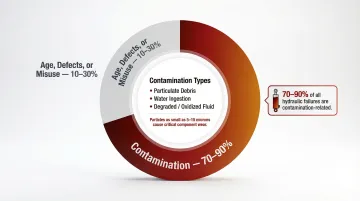
Contaminated fluid is the leading cause of internal pump damage. Schroeder Industries states that 70% to 90% of all hydraulic system wear and failure is contamination-related, with only 10% to 30% traced back to age, defects, or misuse. Particles smaller than component clearances can score cylinder bores and drive wear far faster than visible debris.
Rising Operating Temperature
Elevated operating temperatures indicate the system is working inefficiently—often caused by internal bypass (worn components allowing fluid to recirculate without doing work), low fluid levels, or blocked cooling circuits.
The compounding effect: High temperatures degrade hydraulic fluid faster, reducing its viscosity and lubrication properties, which accelerates wear. Based on the Arrhenius Rate Rule, every 10°C increase in operating temperature doubles the rate of lubricant oxidation, effectively cutting the hydraulic fluid's life in half. If your system is running hot, check fluid levels and cooling circuits before assuming internal pump failure — those are faster and cheaper fixes.
Hydraulic Pump Maintenance Schedule
Maintenance intervals depend on four key factors:
- Operating hours accumulated since last service
- Environment — dusty or contaminated conditions shorten intervals
- Fluid type and its rated service life
- Duty cycle — continuous operation vs. intermittent use
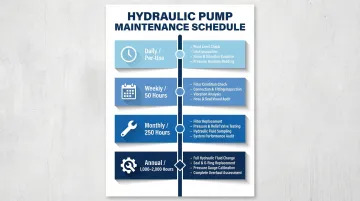
The schedule below reflects general industry guidelines. Adjust intervals to match your specific pump model's manufacturer recommendations.
Maintenance Frequency Table
| Frequency | Maintenance Tasks |
|---|---|
| Daily / Per-Use | Check fluid level and color · Inspect fittings and hoses for leaks · Listen for abnormal noise at startup · Monitor pressure gauge for baseline deviation |
| Weekly / Every 50 Hours | Inspect and drain air filter accumulator · Check oil lubricator drip rate (air-driven pumps) · Verify all connections are tight · Check for vibration or heat at pump housing |
| Monthly / Every 250 Hours | Replace or clean hydraulic filters · Test pressure and flow output against baseline · Inspect seals for early seepage · Sample fluid for contamination or degradation |
| Annual / Every 1,000–2,000 Hours | Full fluid change with filtered oil · Inspect all internal wear components · Replace all O-rings and seals · Calibrate pressure gauges and flow meters · Schedule overhaul or exchange if performance benchmarks are not met |
Two operating scenarios affect interval timing:
- High-usage or continuous-operation equipment (construction, manufacturing): Follow the shorter end of recommended intervals
- Low-cycle or seasonal equipment (agricultural, intermittent industrial): May extend intervals but should not skip annual servicing
Conclusion
Hydraulic pump maintenance is the most reliable way to protect equipment investment, prevent unplanned downtime, and ensure safe operation across every duty cycle.
Combine a daily inspection habit with scheduled preventive service, and learn to recognize the warning signs that call for deeper intervention. When a pump reaches the point of requiring a full rebuild, working with a specialist ensures the unit is returned to manufacturer specifications without extended downtime.
Hydrostatic Transmission Service brings over 100 years of combined hydraulic experience to every rebuild, backs each unit with a 1-year warranty, and offers a Short-Time Exchange Program to keep equipment back in service quickly.
Frequently Asked Questions
How to identify hydraulic pump type?
The three main types are gear, vane, and piston pumps. Identify yours by checking the model label, the application pressure rating, or the visible housing design — each type has a distinct external profile. When in doubt, the manufacturer's service documentation will confirm the classification.
What are the most common causes of hydraulic pump failure?
The four primary causes are fluid contamination (dirt, debris, water), cavitation (vapor bubble formation from low inlet pressure), excessive heat (fluid degradation and seal failure), and uncorrected leaks that allow air ingestion. Scheduled fluid testing and filter changes catch most of these issues before they become costly.
How often should hydraulic pump fluid be changed?
Most systems require a fluid change every 1,000–2,000 operating hours or annually, whichever comes first. Fluid should be tested and potentially changed earlier if it appears dark, cloudy, or contaminated, as degraded fluid accelerates internal component wear.
Can a hydraulic pump be repaired, or does it need to be replaced?
Many pumps can be repaired — seal replacement, cleaning, minor component work — if caught early. Severely worn or damaged units typically require a full rebuild or exchange, where the cost-benefit of a tested, warranted rebuilt unit often outweighs attempting repairs on heavily degraded components.
What tools are needed for basic hydraulic pump maintenance?
Core diagnostic tools: hydraulic pressure gauge, flow meter, thermometer or thermal camera, fluid sampling kit, and leak detection dye. Full disassembly adds torque wrenches and manufacturer-specified seals and assembly compounds.
What is the difference between hydraulic pump repair and rebuild?
Repair typically addresses a specific identified fault (replacing a seal, clearing a blockage), while a rebuild is a comprehensive overhaul—full disassembly, inspection, replacement of all wear components and seals, reassembly to OEM specs, and performance testing. A rebuild restores the pump to OEM performance specifications.