Introduction: Your Guide to the Kawasaki K3VL Parts Catalog
The Kawasaki K3VL is a variable displacement axial piston pump engineered for demanding industrial and mobile hydraulic applications. From excavators and cranes to industrial presses and marine systems, the K3VL delivers reliable high-pressure performance under continuous duty cycles. When a K3VL unit fails, ordering the wrong part—a mismatched seal kit, wrong valve plate, incorrect servo component—turns a one-day repair into a week of downtime.
This guide walks you through model number decoding and a complete parts breakdown by assembly. It covers the most commonly replaced components and how to source the right parts quickly—whether you're ordering individual wear items or evaluating a full rebuild.
TLDR:
- Open-circuit, variable displacement pump rated to 320 bar (4600 PSI) in displacements from 28–200 cc/rev
- Model numbers encode displacement size, control type, and shaft configuration—determining which catalog pages apply
- Rotating group, swashplate/servo, and seal kits are the most frequently replaced assemblies
- 75-80% of hydraulic failures stem from fluid contamination, making valve plate and cylinder block wear the top failure mode
- High-hour or multi-assembly wear units typically deliver better value through rebuild or exchange than piecemeal replacement
What Is the Kawasaki K3VL and Where Is It Used?
The K3VL is a swash-plate type, variable displacement, axial piston pump designed for open-circuit hydraulic systems. It operates at a continuous rated pressure of 320 bar (4600 PSI), with peak pressure capability up to 350 bar (5075 PSI). The K3VL60 variant is rated at 250 bar continuous. Displacement sizes span from 28 to 200 cc/rev, covering a wide range of flow and power requirements.
Primary Applications:
- Construction machinery: excavators, wheel loaders, cranes, and concrete pumps
- Industrial presses: metal forming, injection molding, and stamping equipment
- Marine hydraulics: deck machinery, winches, and steering systems
- Material handling: forklifts, conveyors, and automated storage systems
The K3VL series covers seven displacement sizes — 28, 45, 60, 80, 112, 140, and 200 cc/rev — across multiple control configurations including load sensing, pressure cut-off, and electric displacement control. Always consult the correct variant-specific parts list before ordering any component. A K3VL80 rotating group kit is not interchangeable with a K3VL112 kit, and a load-sensing servo assembly differs entirely from a pressure cut-off regulator.
How to Decode the Kawasaki K3VL Model Number
Every K3VL unit has a model number stamped on the nameplate. Reading it correctly is what gets you to the right page in the parts catalog — and the right parts on the first order.
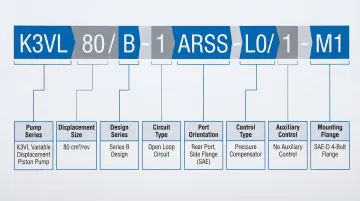
Generic K3VL Model String Example:
K3VL80/B-1ARSS-L0/1-M1
Model Number Segments
| Segment | Example | Meaning |
|---|---|---|
| Pump Series | K3VL | Variable displacement axial piston pump family |
| Displacement Size | 80 | Nominal displacement in cc/rev (28, 45, 60, 80, 112, 140, 200) |
| Design Series | B or C | Internal design generation (B for 45-200 cc; C for 28 cc) |
| Circuit Type | 1 | Open circuit (standard for K3VL) |
| Port Orientation | A, R, S | Port configuration and rotation direction |
| Control Type | L0, P0, E0, Q0 | Regulator/control assembly variant |
| Auxiliary Control | /1, /2, /3 | Torque limiter, power shift options |
| Mounting Flange | M1, M2 | Flange and shaft end configuration |
Control Type Codes (Critical for Parts Selection)
The control type code determines which servo, regulator, and valve components appear in your parts catalog:
- L0/L1: Load Sense & Pressure Cut-Off
- LM/LN: Load Sense & Integral Unload
- LV/LV2: Load Sense & Integral Proportional Relief
- P0: Pressure Cut-Off only
- PM/PN: Pressure Cut-Off & Integral Unload
- PV/PV2: Pressure Cut-Off & Integral Proportional Relief
- Q0: Pilot Operated Displacement Control
- E0: Electric Displacement Control
A K3VL80 with L0 control uses a different servo piston and regulator spring than the same frame with E0 control. Ordering the wrong control assembly parts is the most frequent catalog mistake — and one of the most expensive to undo.
Shaft and Mounting Codes
Shaft seal kits and bearing kits vary by shaft diameter and flange configuration. The mounting flange code (such as M1 or M2) and shaft end designation within the model string determine which seal and bearing part numbers apply. Always cross-reference both the model number and the serial number when sourcing parts — production revisions can quietly shift part numbers between build runs.
Kawasaki K3VL Parts Breakdown by Assembly
The official Kawasaki K3VL parts list is structured in exploded-view assembly drawings tied to numbered part references. Organizing parts by sub-assembly rather than flat part numbers makes diagnosis and rebuild planning far more efficient.
Rotating Group Assembly
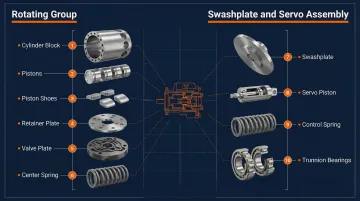
The rotating group is the heart of the pump's displacement mechanism. Core components include:
- Cylinder block — houses the piston bores and rotates against the valve plate
- Pistons — reciprocate within the cylinder block to generate flow
- Piston shoes (slippers) — ride on the swashplate surface, converting rotational motion to axial displacement
- Retainer plate (shoe plate) — holds pistons and shoes together as a matched set
- Valve plate — controls fluid flow between the cylinder block and the pump's inlet/outlet ports
- Center spring — maintains contact between the cylinder block and valve plate
Critical Note: Rotating group components are often sold as a matched set or kit (e.g., Kawasaki part number P-29L42802R for K3VL45 clockwise rotation). Mixing components from different production batches risks premature failure and efficiency loss. Piston-to-cylinder bore clearance is held to extremely tight tolerances—initial clearance is 0.019-0.039 mm, with a replacement limit of 0.040-0.067 mm depending on frame size.
Swashplate and Servo Assembly
The swashplate assembly controls pump displacement by varying the angle of the swashplate. Components include:
- Swashplate — the angled plate against which piston shoes ride
- Servo piston — actuates swashplate angle in response to system pressure or flow demand
- Control spring — provides bias force for the servo piston
- Trunnion bearings — support the swashplate pivot axis
Servo assembly parts vary significantly by control option. A load-sensing servo (L0, L1) uses different springs, spools, and pistons than a pressure compensator (P0) or electric displacement control (E0). The K3VL parts catalog includes separate assembly drawings for each control variant—always confirm your control type code before ordering servo components.
Shaft, Bearings, and Housing
Shaft-end components:
- Drive shaft
- Front shaft seal
- Front and rear bearings (radial and thrust)
- Shaft seal carrier or retainer
Shaft seals are the most frequently replaced K3VL part. Contaminated fluid, excessive case drain pressure, or shaft wear accelerate failure—and seal replacement doesn't require full pump disassembly.
Housing and end cap components:
- Front flange housing
- Rear port cover/end cap
- All associated O-rings and sealing surfaces
Replace housing components only after physical damage; seals and O-rings are routine maintenance items.
Seal Kits and O-Ring Sets
Kawasaki offers complete seal kits for the K3VL that bundle all shaft seals, O-rings, and backup rings needed for a full rebuild. For example, a standard K3VL seal kit (part number P-29L4100S0Y) includes the Viton front shaft seal (P-PMP030F1AKD), Nitrile O-rings (P-00RBG65), and backup rings required for a complete reseal.
Order by full model number—not individual components—to ensure all sealing surfaces are renewed and avoid fitment issues, since seal dimensions vary by displacement size and shaft configuration.
Most Commonly Replaced K3VL Parts and Recommended Service Intervals
Understanding which K3VL parts fail most frequently allows maintenance teams to stock critical spares in advance and avoid extended equipment downtime.
Shaft Seals
The front shaft seal is the single most commonly replaced K3VL part. Contaminated fluid, excessive case drain pressure, or shaft wear can cause premature seal failure. Shaft seal replacement is a routine service item that does not require full pump disassembly—most technicians can replace a shaft seal in under an hour with basic hand tools.
Valve Plate and Cylinder Block
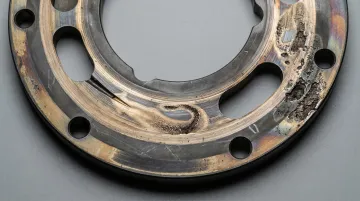
The valve plate and cylinder block bore are highly susceptible to scoring and erosion when hydraulic fluid is contaminated or depleted of anti-wear additives. Over 75% of all hydraulic system failures are a direct result of contamination, and valve plate scoring is one of the most visible consequences.
Particulate contamination and inappropriate oil selection aggravate friction in the valve plate pair, leading to scoring, increased heat generation, and volumetric efficiency loss. Valve plate surface roughness must be maintained at 0.4Z or less after repair—beyond that, the hydrodynamic film between the valve plate and cylinder block breaks down, accelerating wear.
Piston Shoes (Slippers)
Slipper pad wear is a primary indicator of high-cycle fatigue and contaminated fluid. Worn slippers cause volumetric efficiency loss measurable through case drain flow testing—a diagnostic technique technicians should know. Monitoring case drain flow provides a direct indication of the internal wear state of the pump. Internal leakage from piston/bore clearances and piston/shoe assemblies collects in the pump case and returns via the case drain line.
Piston-to-shoe endplay must not exceed 0.1 mm—beyond that limit, slippers should be replaced as a matched set with the retainer plate.
Bearings
Both radial and thrust bearings have finite fatigue life tied to operating load and speed. Bearing failure often presents as noise or shaft play before catastrophic failure. Follow a maintenance and overhaul schedule based on L10 bearing life calculations rather than a fixed time interval.
Bearing life is heavily influenced by fluid cleanliness (minimum recommended ISO 4406 level of 20/18/15), fluid temperature, and operating pressure.
Proactive bearing replacement during major overhauls prevents unplanned downtime and secondary damage to the shaft and housing.
Control/Servo Components
Servo spool wear or spring fatigue in the control assembly causes pressure or flow regulation drift. These symptoms are often misdiagnosed as system-level issues before the pump control is ever inspected.
If your K3VL exhibits inconsistent pressure regulation, hunting, or flow instability, inspect the servo assembly for wear before troubleshooting downstream valves or actuators.
OEM, Aftermarket, or Full Rebuild — Which Path Is Right?
When sourcing K3VL parts, you have three primary strategies: purchasing genuine Kawasaki OEM replacement parts, using third-party aftermarket components, or pursuing a complete pump rebuild or exchange.
OEM Parts
Genuine Kawasaki parts meet the tight dimensional tolerances required for the K3VL rotating group and slipper pads. Clearances are held to extremely tight specifications—cylinder-to-piston clearance ranges from 0.019-0.039 mm initially, with a replacement limit of 0.040-0.067 mm depending on frame size. OEM parts ensure matched tolerances and preserve any existing warranty coverage.
Aftermarket Parts
Aftermarket parts are typically 20% to 50% less expensive than OEM parts, but dimensional tolerances in the rotating group and slipper pads are critical. Substandard aftermarket components can accelerate wear or cause premature failure in high-pressure applications. If you choose aftermarket parts, verify that the supplier provides OEM-equivalent specifications and dimensional tolerances—not just "compatible" parts.
Full Rebuild or Exchange
For situations where multiple assemblies are worn simultaneously or the pump has high hours across all components, a full rebuild or exchange is often more economical than sourcing individual parts. Professionally rebuilt hydraulic pumps typically perform comparably to new parts while offering 40% to 60% cost savings.
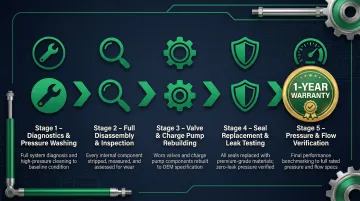
Hydrostatic Transmission Service (HTS) offers a Short-Time Exchange Program for K3VL units. Rebuilt pumps are tested to manufacturer specifications and come with a 1-year warranty. Each rebuilt unit goes through a documented process before it ships:
- Comprehensive diagnostics and pressure washing
- Full disassembly, solvent cleaning, and component inspection
- Valve rebuilding, manifold rebuilding, and charge pump reconstruction
- Seal replacement and leak testing
- Pressure and flow adjustment verified against manufacturer specifications using Statistical Process Control Systems
How to Source and Order K3VL Parts
Follow this process to source K3VL parts correctly:
- Locate the full model number and serial number from the pump nameplate
- Reference the correct assembly drawing in the parts catalog to identify the part reference number
- Contact an authorized Kawasaki distributor or specialist hydraulic supplier with both the part reference number and the model number to confirm compatibility
The official Kawasaki K3VL spare parts list is available through Kawasaki Precision Machinery's authorized distributor network and the client zone on their website. Always verify you're using the revision-matched parts list for your unit's serial number range — Kawasaki revises part numbers between production runs.
For example, the K3VL parts list updated in May 2017 notes: "K3VL112/140 swashplate supports had a running design change — old models require 2 plus, new design only 1."
Once you have the sourcing process down, the next step for fleet operators is getting ahead of failures before they happen. Teams managing multiple K3VL-equipped machines can significantly reduce unplanned downtime by maintaining a stocking list of critical wear parts — seal kits, valve plates, and slipper sets are the usual culprits. Hydrostatic Transmission Service maintains K3VL Series units in warehouse inventory and operates an international buyer program, making it a practical option for sourcing both common and hard-to-find components.
Frequently Asked Questions
What displacement sizes are available in the Kawasaki K3VL series?
The K3VL series includes displacement variants of 28, 45, 60, 80, 112, 140, and 200 cc/rev. Each size has its own dedicated parts catalog pages, making correct size identification essential before ordering.
How do I find the official Kawasaki K3VL parts list?
The official K3VL spare parts list is available through Kawasaki Precision Machinery's authorized distributors and their client zone portal. You need your full model and serial number to access the correct document and ensure you're referencing the revision-matched parts list for your unit.
What is included in a Kawasaki K3VL seal kit?
A K3VL seal kit typically includes the front shaft seal, all internal O-rings, backup rings, and any sealing gaskets needed for a complete internal seal renewal. Kits are ordered by model number to ensure correct fitment, as seal dimensions vary by displacement size and shaft configuration.
How can I tell if my K3VL pump needs a repair or a full rebuild?
Shaft seal leaks or minor efficiency loss usually need only targeted part replacement. Excessive noise, high case drain flow, or pressure regulation drift across multiple systems point toward a full rebuild — at that stage, piecemeal repairs cost more than an exchange.
Are aftermarket parts safe to use in the Kawasaki K3VL?
The K3VL rotating group operates at piston-to-cylinder clearances of 0.019–0.039 mm, so OEM or OEM-equivalent parts are strongly recommended. Low-cost aftermarket components that miss these tolerances accelerate wear and risk failure under high-pressure operating conditions.
What causes the K3VL valve plate to wear out prematurely?
Valve plate scoring is most commonly caused by particulate contamination or hydraulic fluid that has dropped below minimum viscosity and anti-wear specifications. Either condition destroys the hydrodynamic film between the valve plate and cylinder block, resulting in metal-to-metal contact and accelerated wear.